Light Requirements
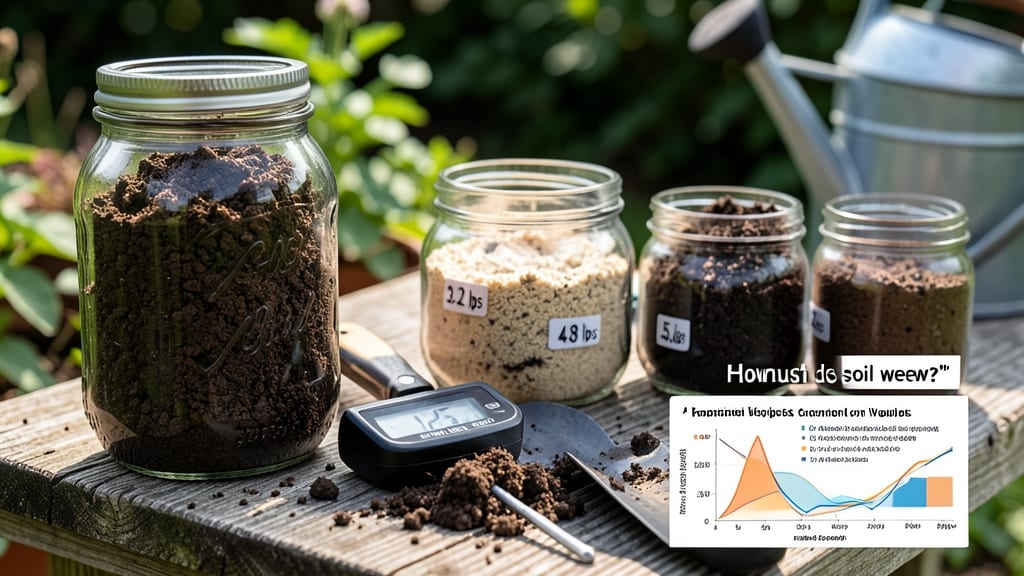
Determining soil weight depends on its composition and moisture: dry loamy soil typically weighs around 100 pounds per cubic foot, while saturated clay can exceed 130 pounds. Organic mixes with compost are lighter (~70-90 lbs), and gravelly soils may range from 80-100 lbs. Moisture content alone can increase weight by 10-30% based on saturation.
Understanding soil weight matters because it directly impacts everything from garden planning to construction projects. 🌱 The variations you see—like clay's heavier density or compost's lighter profile—come from particle size and organic content. Clay holds more water and compacts tightly, while sandy soils drain quickly but stay lighter.
Even a small raised bed filled with 1 cubic foot of saturated clay could weigh over 130 pounds, which is critical for structural support or transportation.
For gardeners, this means choosing the right soil mix for containers or raised beds isn't just about nutrients—it's also about managing weight for stability and ease of handling.
💡 In This Article
- Soil Density and Weight Factors by Composition
- Practical Soil Weight Charts for Garden Planning
Soil density and weight factors by composition
The weight of soil isn't just about how much space it occupies—it's a complex interplay of particle size, mineral composition, and how tightly those particles pack together. Clay particles, for example, are tiny (less than 0.002 millimeters) and plate-shaped, allowing them to stack closely when wet.
This creates a dense matrix that can hold up to 60% water by volume, which is why saturated clay soil often exceeds 130 pounds per cubic foot.
In contrast, sandy soils have larger particles (0.05-2 millimeters) that don't pack as tightly, leaving more air space and reducing weight to around 80-100 pounds per cubic foot when dry. 🌍
Organic matter plays a dramatic role too. Pure mineral soil (like clay or sand) has a bulk density of 1.2-1.6 grams per cubic centimeter, but adding compost or peat moss can drop that to 0.8-1.0 g/cm³.
This is because organic materials are porous and lightweight—think of how a handful of dry leaves weighs far less than the same volume of wet clay. Even a 30% compost amendment can reduce soil weight by 15-20%, making it ideal for container gardens where weight matters.
The science here involves porosity: organic soils have 50-70% air space, while mineral soils average only 30-40%.
Compaction is another game-changer. Foot traffic or machinery can reduce pore space by 30-50%, increasing weight dramatically. For instance, a loose garden soil might weigh 90 pounds per cubic foot, but after compaction, it could jump to 110 pounds.
This is why construction sites test soil density before building—structural engineers use a proctor test to measure how much weight soil can bear based on its compaction level. The same principle applies to your garden: heavily walked paths will compact soil, making it heavier and less fertile over time. ✨
Moisture's impact is often underestimated. Water weighs 62.4 pounds per cubic foot itself, and soil can absorb 10-30% of its dry weight in water. A cubic foot of dry loam (100 lbs) becomes 130-140 lbs when saturated—a 30% increase.
The key difference lies in capillary action: clay holds water tightly between particles, while sand drains quickly. This is why clay feels heavy when wet but crumbles when dry, while sandy soil stays relatively consistent in weight regardless of moisture.
For gardeners, this means checking soil moisture before estimating weight—especially for raised beds or containers.
Let's break down the particle size hierarchy and its weight impact:
- Clay: Tiny particles (<0.002 mm) create dense packing, high moisture retention → 130-160 lbs/cubic foot when saturated
- Silt: Medium particles (0.002-0.05 mm) moderate density → 100-120 lbs/cubic foot
- Sand: Large particles (0.05-2 mm) loose packing, low moisture → 80-100 lbs/cubic foot
- Organic: High porosity, low bulk density → 70-90 lbs/cubic foot
Understanding these factors helps explain why a 5-gallon pot of potting mix (lighter, organic) feels manageable while a wheelbarrow of clay soil becomes a workout. The same principles apply whether you're designing a high-rise foundation or a container garden—weight distribution matters at every scale. 💫