
How To
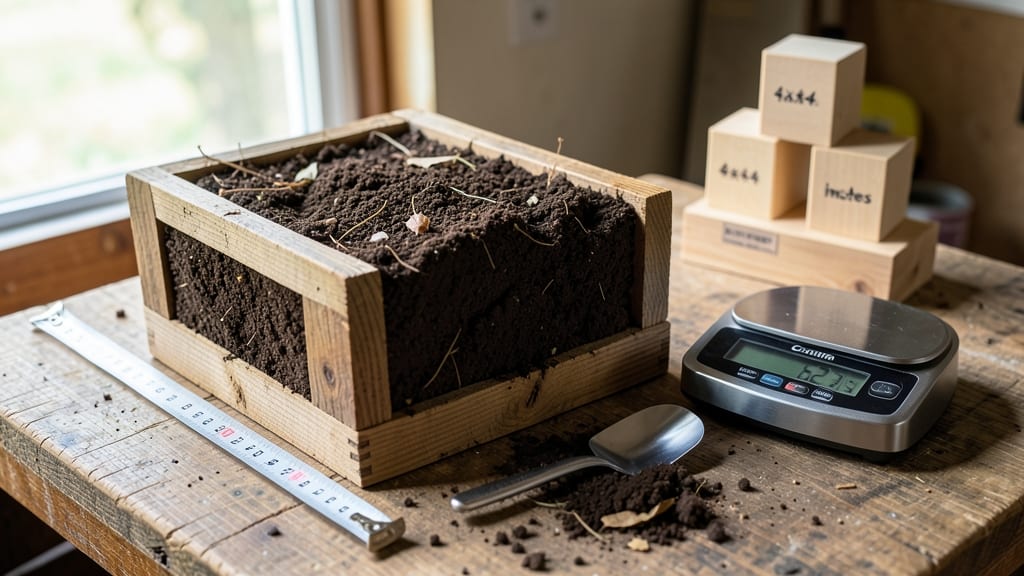
One cubic foot of soil equals how many pounds? It weighs between 40 to 120 pounds depending on its composition, moisture content, and compaction—sandy soil is lighter (40-60 lbs) while clay-heavy soil can exceed 100 lbs when saturated.
Understanding soil weight is key for gardeners and landscapers, especially when moving or mixing large volumes.
The variation comes from how tightly packed the particles are—sandy soils have large air gaps, making them lighter, while clay holds moisture and compacts more densely. 🌱 For example, a raised bed filled with loamy soil (a mix of sand, silt, and organic matter) might weigh around 70-80 pounds per cubic foot when damp, but dry clay could push closer to 110 pounds.
This difference affects everything from container selection to structural support for heavy planters.
Moisture plays a huge role too—water adds significant weight, sometimes doubling the dry soil mass. That's why I always check moisture levels before estimating for projects like building a retaining wall or filling a large pot.
Pro tip: Use a moisture meter or squeeze a handful—if it holds shape, it's heavy; if it crumbles, it's lighter. This simple test helps avoid overloading wheelbarrows or underestimating project requirements.
💡 In This Article
- Soil Density and Weight Variations by Composition
- Practical Weight Calculations for Gardening Projects
Soil density and weight variations by composition
The weight of soil per cubic foot varies dramatically based on its mineral makeup and particle structure. Sandy soil, with its large grains and high porosity, typically ranges from 40 to 60 pounds because air and water occupy about 40% of its volume.
The particles themselves are dense, but the spaces between them reduce overall mass. In contrast, clay soil—composed of tiny, tightly packed platelets—can weigh 100 to 120 pounds when saturated, as its structure traps water and compresses under pressure. 🌍
Silt, the middle ground between sand and clay, usually falls in the 60-80 pound range due to its balanced particle size.
Organic matter, like decomposed leaves or compost, adds complexity: while it’s lightweight when dry (20-30 pounds per cubic foot), it absorbs moisture like a sponge, potentially doubling its weight when wet.
This is why gardeners often mix organic materials into heavier soils—they improve aeration and reduce compaction without drastically altering weight.
Moisture content is the wild card here. A cubic foot of dry clay might weigh 90 pounds, but after a rainstorm, that same volume could swell to 115 pounds as water fills the microscopic gaps.
The science behind this lies in specific gravity: clay minerals have a higher density than sand, and their layered structure creates more surface area for water adhesion. For example, kaolinite clay can hold 30-50% of its weight in water, while sandy loam retains only 10-20%**.
Porosity also plays a role—soils with more air pockets (like sandy loam) are easier to move but less stable for structures. When planning a project, consider the bulk density, which combines particle density with pore space.
A high bulk density (like in clay) means heavier loads for containers or raised beds. For instance, a 4'x8' raised bed filled with clay soil would weigh roughly 1,280 pounds when saturated, compared to just 640 pounds for sandy soil. 💫
Even within soil types, variations exist. For example, volcanic soils (like andisols) can be 20% lighter than typical clay due to their porous glass fragments. Meanwhile, peat-based soils (common in bogs) might weigh only 15-25 pounds per cubic foot dry, but their waterlogged state can make them surprisingly heavy.
Understanding these nuances helps gardeners choose the right soil for their needs—whether it’s lightweight potting mix or heavy-duty clay for structural projects.