
How To
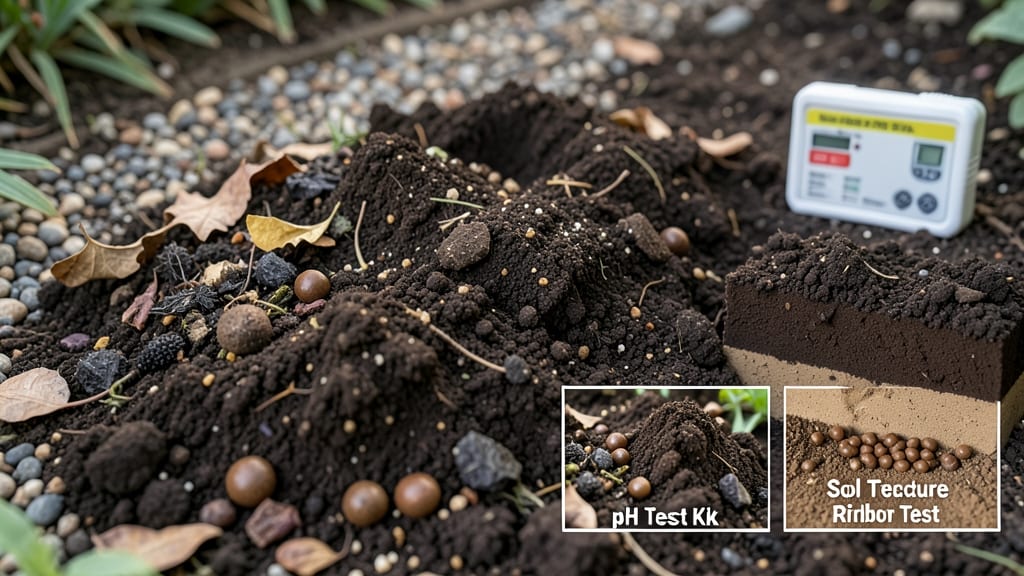
Loamy soil is made of roughly equal parts sand (40%), silt (40%), and clay (20%), combined with 5% organic matter like decomposed leaves, compost, and microorganisms for optimal plant growth and nutrient retention.
Loamy soil's magic lies in its balanced mineral composition—sand provides gritty structure for drainage, silt holds moisture like a sponge, and clay acts as a glue to bind everything together. 🌱 This trio creates tiny air pockets that roots love while preventing nutrients from washing away.
Think of it like a perfect cake batter: each ingredient plays a crucial role, and skipping one throws off the whole recipe. The organic matter acts as the "secret ingredient," feeding beneficial microbes that break down nutrients into forms plants can actually use.
What's fascinating is how this balance directly affects plant health. Too much sand drains water too quickly, while too much clay suffocates roots by trapping moisture. The ideal loam gives plants both hydration and oxygen—like a Goldilocks zone for growth.
Many gardeners don't realize their soil might be off until they notice stunted plants or water running right through without soaking in.
💡 In This Article
- The Ideal Loam Composition: Sand, Silt, and Clay Ratios Explained
- How to Test and Improve Your Garden’s Loam Content
The ideal loam composition: sand, silt, and clay ratios explained
The 40-40-20 ratio of sand, silt, and clay in loamy soil isn't arbitrary—it's the result of millions of years of natural weathering and biological activity. Sand particles (0.05-2mm in diameter) create the soil's skeletal structure, preventing compaction while allowing excess water to drain away.
Silt (0.002-0.05mm) acts like microscopic sponges, holding water and nutrients near plant roots where they're most accessible. Clay (<0.002mm) particles, though tiny, carry an electrical charge that attracts and holds onto nutrients like a magnetic surface.
What makes this combination work so well is how these particles interact physically. The sand provides the "backbone" that prevents the soil from becoming impermeable, while the silt and clay fill the spaces between sand grains, creating a porous network.
This structure allows for both water retention and oxygen circulation—critical for root respiration. 🌱 Imagine holding a handful of loamy soil: it should feel slightly gritty (sand), smooth when moist (silt), and have just enough stickiness (clay) to form a weak ribbon when squeezed between your fingers.
The organic matter then acts as the "glue" that binds these minerals together, preventing them from separating during watering or rain.
The particle size distribution creates what soil scientists call "aggregates"—clusters of sand, silt, and clay bound by organic materials. These aggregates range from 0.25-10mm in diameter and are what give loamy soil its crumbly, almost cake-like texture when moist.
This structure is crucial because it determines how well water moves through the soil (percolation rate) and how easily roots can penetrate. For comparison, pure sand has almost no aggregate structure, while pure clay forms dense, waterlogged clumps that suffocate roots.
Organic matter plays an equally vital role in maintaining this structure. It contributes to the 5% organic component that includes decomposed plant material, fungal hyphae, and bacterial colonies. These organisms produce sticky substances called polysaccharides that physically bind soil particles together.
Without this organic "glue," the mineral components would separate during watering, leading to erosion and nutrient loss. The organic matter also serves as a slow-release fertilizer, breaking down into nutrients like nitrogen, phosphorus, and potassium that plants can absorb over time.
Here's what happens when the balance shifts: Too much sand (60%+) creates "flashy" soil that drains water too quickly, while too much clay (40%+) makes soil dense and waterlogged.
The ideal loam maintains a 30-50% porosity—meaning about half the soil volume is air and water-filled pores. This porosity is what allows roots to breathe while providing consistent moisture.
Many gardeners unknowingly have soil that's either too sandy (common in desert regions) or too clay-heavy (typical in humid climates), which is why soil testing and amendments are often necessary to achieve this perfect balance.
Consider this visual comparison: Sandy soil resembles a sieve—water and nutrients pass right through. Clay soil acts like a sponge that's been wrung out—it holds water but won't release it.
Loamy soil, however, behaves like a well-wrung sponge: it holds just enough moisture while allowing excess to drain, and it releases nutrients at a rate plants can use.
This is why loamy soils are often found in the most productive agricultural regions of the world, from the breadbasket of the American Midwest to the fertile river valleys of Europe. 🌍