
Landscaping
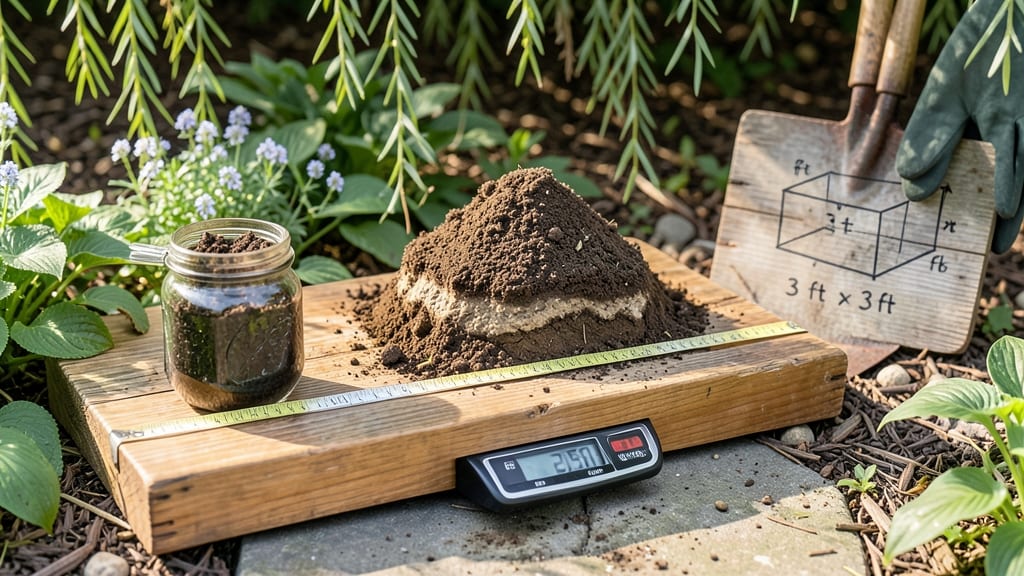
The weight of soil per cubic yard depends entirely on its type: dry clay ranges from 2,400–2,700 pounds, sandy soil sits at 2,600–3,000 pounds, and loamy soil weighs 2,200–2,500 pounds. Moisture levels can add anywhere from 100–500+ pounds, so always factor in saturation and organic content for precise calculations in landscaping projects.
The weight of soil per cubic yard isn't just about the dirt itself—it's a science of particle density and moisture interplay.
Clay particles pack tightly, making them heavier, while sand's coarse grains leave more air pockets, reducing overall weight. Loamy soil, the gardener's gold standard, strikes a balance with its mix of minerals, silt, and organic matter, giving it a lighter yet nutrient-rich profile.
What's fascinating is how moisture plays the biggest role: a saturated cubic yard of sandy soil can weigh nearly 3,500 pounds—double its dry weight! For accurate planning, I always check moisture levels first, especially before heavy landscaping tasks.
Understanding these variations helps avoid costly mistakes.
For example, a raised garden bed filled with moist loamy soil might require 2,800 pounds of support, while the same bed with dry clay could need 3,000 pounds or more. Compaction from foot traffic or machinery can also shift weights by hundreds of pounds, so always test soil density before major projects.
This knowledge isn't just theoretical—it directly impacts everything from foundation prep to plant health, where root systems need the right balance of weight and aeration.
💡 In This Article
- How Soil Composition Affects Its Weight Per Cubic Yard
- Practical Ways to Estimate Soil Weight for Garden Projects
How soil composition affects its weight per cubic yard
The weight of soil per cubic yard is fundamentally about particle size and arrangement. Clay particles are flat and plate-like, packing densely together with minimal air space—this tight structure gives clay its high weight range of 2,400–2,700 pounds per cubic yard.
Imagine a stack of fine, heavy plates versus loose sand grains: the clay's surface area creates stronger molecular bonds between particles, reducing void space. In contrast, sandy soil's coarse grains create larger air pockets, making it surprisingly lighter at 2,600–3,000 pounds despite its granular appearance.
Loamy soil's balanced composition explains its lighter weight of 2,200–2,500 pounds. This ideal garden soil combines roughly 40% sand, 40% silt, and 20% clay, plus organic matter that adds structure without excessive density.
The silt particles—smooth and microscopic—fill gaps between sand and clay, creating a porous yet stable matrix. Organic matter further reduces weight by adding air spaces, while its fibrous structure improves water retention without adding significant mass.
This is why gardeners prize loam: it's the only soil type where weight actually correlates with fertility.
Moisture transforms these weights dramatically through capillary action. Clay's tiny particles create microscopic channels that hold water tenaciously, while sand's larger grains drain quickly. A saturated cubic yard of clay can weigh 3,000+ pounds—nearly 30% more than dry—because water fills those dense particle arrangements.
Sandy soil, however, might only gain 100–200 pounds when wet due to its natural drainage. The key factor? Porosity: clay's low porosity means water adds significant weight, while sand's high porosity limits water retention and thus weight gain.
Compaction further alters these calculations through mechanical pressure. Foot traffic or heavy machinery can reduce air pockets by 20–30%, increasing clay's weight by 300–500 pounds per cubic yard. This explains why construction sites often see soil weights exceeding standard ranges.
In gardening, compaction from tilling or planting can similarly increase weight, which is why aerating tools are essential for maintaining proper soil structure. The science here is simple: less air = more weight, and that directly impacts everything from foundation stability to plant root development.
Organic matter adds another layer of complexity. Compost or peat moss can reduce soil weight by 10–20% per cubic yard while improving fertility, as these materials contain 30–50% air by volume. However, they also increase water retention, which can offset some of that weight reduction.
For precise calculations, I always recommend testing both dry bulk density (weight per volume) and moisture content separately—this two-step approach reveals the full picture of what you're actually working with in your garden or landscape.
What most people overlook is how these factors interact. For example, a sandy-loam mix might weigh 2,300 pounds dry but 2,800 pounds when moist—yet if compacted, that same volume could reach 3,000 pounds.
This variability is why professional landscapers carry moisture meters and soil density gauges: they're not guessing, they're measuring the exact conditions on site. Understanding these interactions lets you make smarter decisions about everything from irrigation needs to structural support for raised beds.