
How To
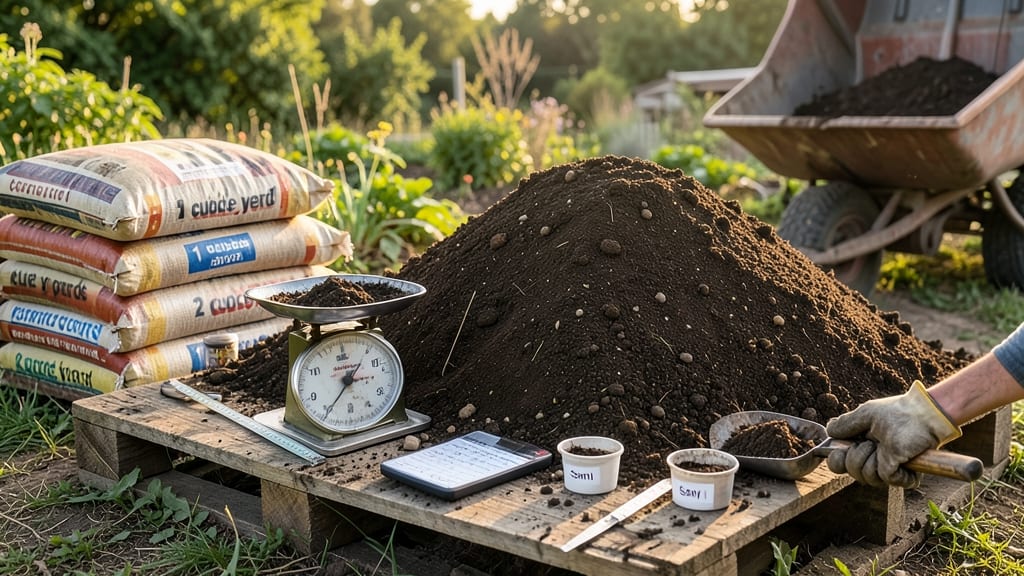
To convert one ton of soil to cubic yards, you'll typically get between 0.75 and 1.25 cubic yards, depending on the soil type—clay-heavy soil weighs more per cubic yard while sandy soil is lighter.
Understanding this conversion is crucial because soil isn't uniform—its moisture content, organic matter, and particle size all affect how much space it occupies. For example, topsoil often falls in the middle of this range, while compost can be even lighter due to its air pockets.
I always recommend checking local density charts before ordering, as regional soil compositions vary. This small step can save you from buying too much or running out mid-project.
For practical purposes, think about your project's scale. A 10x10-foot raised garden bed filled 12 inches deep needs about 0.75 cubic yards of soil—roughly 0.8 tons if using standard topsoil. Using the wrong estimate could mean hauling extra trips or leaving gaps in your landscape. 💫
💡 In This Article
- Soil Density Variations by Type: Why Weight-to-Volume Ratios Differ
- Practical Conversion Chart for Gardeners: Cubic Yards vs Tons by Soil
Soil density variations by type: why weight-to-volume ratios differ
Soil density isn't one-size-fits-all because it depends on the particle size distribution and organic content. Sandy soil, made up of large particles with lots of air gaps, weighs about 2,400 pounds per cubic yard—meaning one ton covers roughly 1.25 cubic yards.
Clay soil, with tiny particles that pack tightly, can weigh up to 2,800 pounds per cubic yard, reducing that same ton to just 0.75 cubic yards. The difference comes down to how much air exists between particles: sand has 40% air space, while clay has only 20%.
Moisture content adds another layer—wet soil can weigh 20-30% more than dry soil due to water filling those air gaps. For example, loamy soil (a balanced mix of sand, silt, and clay) typically falls around 2,600 pounds per cubic yard, giving you about 0.9 tons per cubic yard.
Meanwhile, compost, with its high organic matter and air pockets, might only weigh 1,500 pounds per cubic yard, making one ton stretch to 1.67 cubic yards. This is why gardeners often need more compost by volume than by weight.
The science behind this involves bulk density, measured in pounds per cubic foot. Sandy soils often show 90-100 pounds per cubic foot, while clay soils can exceed 110 pounds per cubic foot.
This measurement helps explain why a wheelbarrow of sandy soil feels lighter than one of clay, even if they appear the same volume. Understanding these variations helps you avoid ordering too little for large projects or too much for smaller ones—both mistakes can cost time and money.
Here's what this means for your project: If you're filling a 4x8-foot raised bed 12 inches deep, you'll need about 1.6 cubic yards of soil. Using topsoil (around 2,500 pounds per cubic yard), that's roughly 1.3 tons.
But if you switch to peat moss (lighter at 1,200 pounds per cubic yard), you'd need 1.9 tons for the same volume. These calculations become even more critical when working with landscaping projects covering hundreds of square feet.
For precise planning, always check local soil density charts from your supplier or extension service. These charts account for regional variations in soil composition. For instance, clay-heavy soils in the Midwest might differ significantly from sandy coastal soils.
A quick phone call to your supplier can save you from guessing—which is especially important when dealing with heavy equipment like skid steers or dump trucks.
One common mistake is assuming all "soil" behaves the same. Fill dirt (often a mix of clay, sand, and gravel) can weigh 2,800 pounds per cubic yard, while mulch might only weigh 800 pounds per cubic yard.
This 3.5x difference in density highlights why knowing your material matters. Always ask for the dry bulk density measurement when ordering—this gives you the most accurate conversion for your project.
Remember: The more organic matter and air pockets in your soil, the lighter it will be by weight but heavier by volume. This is why compost-amended soil often requires more cubic yards per ton than standard topsoil.
For example, a 50-50 mix of topsoil and compost might only weigh 2,000 pounds per cubic yard, giving you about 1.5 cubic yards per ton. These nuances explain why professional gardeners carry density charts in their trucks—precision matters when every cubic yard counts.