How To
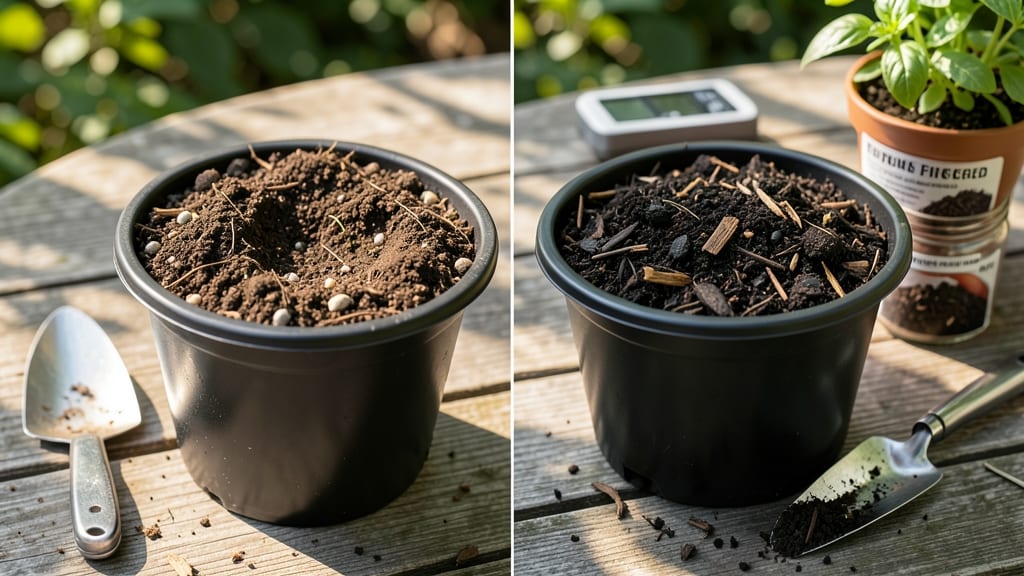
Soil and compost aren't the same thing: soil is the natural growing medium containing minerals, organic matter, and living organisms, while compost is decomposed plant/animal material that boosts soil fertility but lacks its structural integrity. Think of compost as a nutrient supplement rather than a standalone growing base.
Soil forms the foundation where plants anchor and access water, minerals, and air through its complex structure of clay, sand, and silt particles.
Compost, on the other hand, is essentially "finished" organic matter that breaks down further to release nutrients. 🌱 While compost can dramatically improve soil health by adding nitrogen, phosphorus, and potassium, it doesn't replicate soil's physical properties needed for root development.
Many gardeners use compost as a top dressing or mix it into soil to create a richer growing environment, but pure compost alone won't support plant growth long-term.
For example, when planting vegetables like tomatoes or peppers, I always recommend mixing compost with existing garden soil at a ratio of about 20-30% compost. This combination gives plants both the structural support of soil and the nutrient boost from compost.
The key difference lies in their roles: soil provides the framework for growth, while compost acts as the fertilizer that keeps that framework productive over time.
💡 In This Article
- Understanding Soil vs Compost Composition
- When and How to Use Compost in Gardening
Understanding soil vs compost composition
Soil is a complex ecosystem composed of roughly 45% minerals (sand, silt, clay), 25% water, 25% air, and 5% organic matter—this last component being the decomposed plant/animal material that eventually becomes compost. The mineral fraction provides structural support for roots while regulating water retention and drainage.
For instance, sandy soils drain quickly but lack nutrients, while clay soils hold water and minerals too tightly, suffocating roots. 🌱 The organic matter in soil acts as a glue between mineral particles, creating stable aggregates that hold air and water for plant roots.
Compost, by contrast, is primarily organic material that has undergone decomposition—think of it as the end product of this process.
A well-made compost pile reaches temperatures of 130-160°F during active decomposition, killing weeds and pathogens while transforming complex materials like grass clippings or kitchen scraps into a dark, crumbly substance rich in nutrients.
Unlike soil, compost lacks the mineral structure needed for root anchorage; its primary value lies in its nutrient density, containing 2-3% nitrogen, 0.5-1% phosphorus, and 0.5-1% potassium by weight, along with beneficial microbes that break down further when added to soil.
The key difference in their roles becomes clear when you examine their physical properties. Soil's particle structure—whether sandy, loamy, or clay—creates pores that allow both water and air to reach roots. Compost, while excellent for adding nutrients, doesn't replicate this structure.
When used alone, it compacts over time, reducing aeration and creating an environment where roots struggle to establish. This is why gardeners often mix compost with existing soil at ratios like 1 part compost to 3 parts soil—the soil provides the structure while the compost supplies the nutrients.
Consider the microbial communities: soil hosts thousands of species of bacteria, fungi, and protozoa that form symbiotic relationships with plant roots. Compost contains these microbes too, but in different proportions and activity levels.
When added to soil, compost microbes work in tandem with native soil microbes to break down organic matter more efficiently, creating a feedback loop that sustains plant growth over time. Without the soil's physical framework, however, these beneficial relationships can't fully develop, limiting plant health.
One visual way to understand this is to compare a loaf of bread to a bag of flour. Soil is like the baked loaf—it has structure, texture, and the ability to support life.
Compost is more like the flour: it contains all the ingredients needed to make bread, but on its own, it won't rise or hold together. The two work together to create something greater than either could achieve alone. 🌿
For example, when growing heavy feeders like corn or squash, I've seen firsthand how adding 3-4 inches of compost to the top of existing garden soil can boost yields by up to 30% compared to soil without compost.
The compost provides the immediate nutrients, while the soil's structure ensures the plants can access those nutrients without stressing their root systems.