Tools
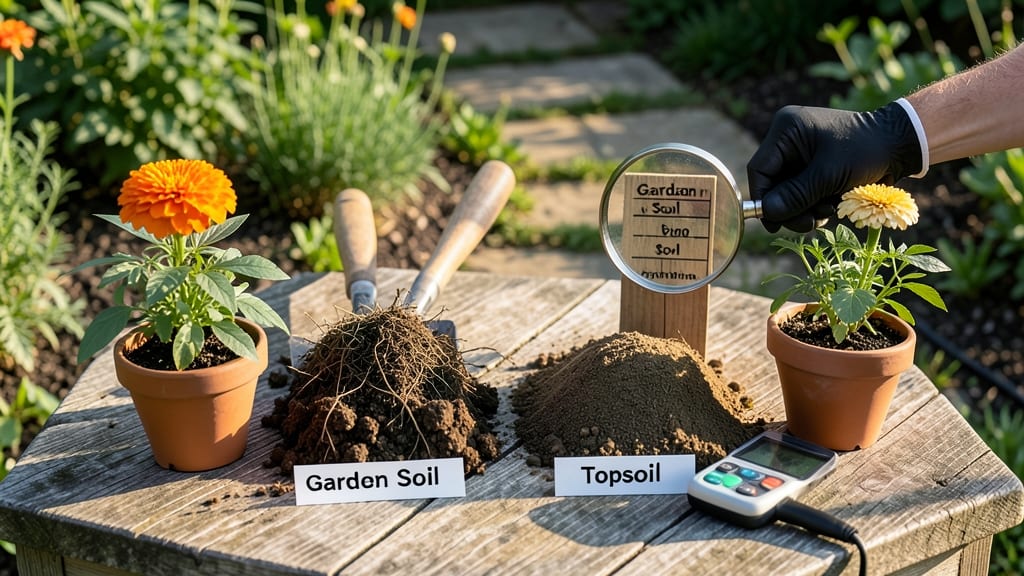
Garden soil and topsoil are not the same: topsoil is the uppermost fertile layer naturally rich in organic matter, while garden soil is often a blended mix of topsoil, compost, and amendments for optimized plant growth. Their compositions and uses differ significantly.
Garden soil is specifically formulated for planting, often enriched with compost, sand, or fertilizer to boost nutrient levels and improve drainage.
Unlike natural topsoil—which forms over centuries through decomposition—garden soil is a human-made blend designed for immediate plant growth. 🌱 For example, topsoil works best for leveling uneven lawns or establishing new grass, while garden soil excels in vegetable beds where roots need extra nutrients.
The key difference lies in their purpose: one is nature's gift, the other is a gardener's tool.
Many gardeners mistakenly assume topsoil alone will yield great results, but its organic matter content can vary widely depending on the source. A simple test—like squeezing a handful—reveals the difference: topsoil crumbles easily, while garden soil holds its shape better due to added binders.
For container gardening, I always recommend pre-mixed garden soil to ensure consistent moisture retention and nutrient availability.
💡 In This Article
- Composition Breakdown: Topsoil vs Garden Soil
- Best Uses for Topsoil and Garden Soil in Landscaping
Composition breakdown: topsoil vs garden soil
Topsoil is nature's own nutrient-rich layer, typically containing 5-10% organic matter formed over centuries through decomposition of leaves, plants, and animal matter. This layer naturally holds 2-5% nitrogen, 0.1-0.3% phosphorus, and 0.5-1.5% potassium—essential nutrients for plant growth.
The particle structure varies but often includes 45% mineral particles, 5% organic matter, and 50% pore space for air and water circulation. 🌱
Garden soil, however, is a carefully engineered blend designed to optimize plant health. It often combines topsoil with 20-30% compost, 10-20% perlite or vermiculite for aeration, and 5-10% fertilizer to boost nutrient density immediately.
For example, a typical vegetable garden mix might contain 60% topsoil, 20% compost, 10% coconut coir, and 10% worm castings—creating a structure that holds moisture while preventing compaction. The organic matter content can exceed 15%, far surpassing natural topsoil.
One key difference lies in their formation processes. Topsoil develops naturally through soil-forming factors like climate, organisms, and parent material over 100-1,000+ years. Garden soil, however, is created through human intervention—mixing, sterilizing, and amending components to achieve specific properties.
This explains why garden soil often has a darker, richer appearance and a lighter, fluffier texture compared to denser natural topsoil. 🌿
The nutrient availability also differs significantly. Natural topsoil releases nutrients slowly through microbial activity, while garden soil provides an immediate nutrient boost due to added fertilizers and compost.
For instance, a 1-gallon bag of garden soil might contain 5-10 times more available nitrogen than natural topsoil, making it ideal for seed starting and young plants that need rapid growth.
The pH balance is another critical factor—garden soil is typically adjusted to 6.0-7.0, while natural topsoil can vary widely from 4.5-8.5 depending on location.
Consider the particle size distribution as another distinguishing factor. Natural topsoil often contains a mix of sand, silt, and clay particles in varying proportions, creating what's called a "loam" texture. Garden soil, however, is often designed with a more uniform particle distribution to prevent compaction.
For example, a well-balanced garden mix might contain 40% sand, 30% silt, and 30% organic matter, creating optimal conditions for root penetration and water retention. This engineered structure helps prevent the crusting that often occurs with natural topsoil when exposed to rain or irrigation.
Finally, the microbial life differs between the two. Natural topsoil contains a diverse ecosystem of beneficial microbes that develop over time, while garden soil often includes added microbial inoculants to jumpstart decomposition and nutrient cycling.
This is why garden soil can support vigorous plant growth almost immediately after planting, whereas natural topsoil may require a season or two to establish its microbial community. 🔬