
Light Requirements
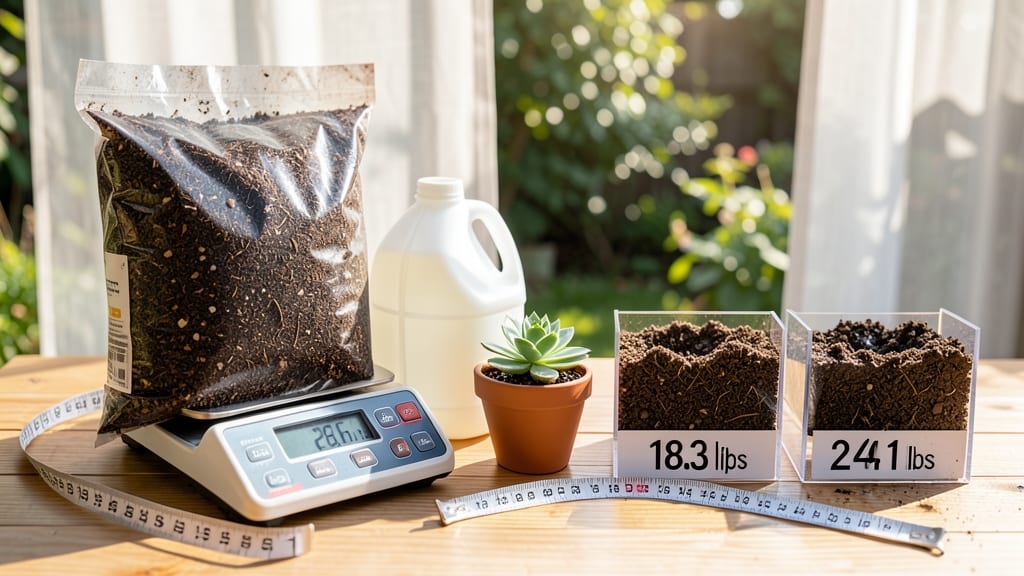
To determine how much 0.75 cubic feet of garden soil weighs, expect 15 to 25 pounds depending on moisture, organic content, and soil composition—sandy mixes stay lighter (15-18 lbs), while clay-heavy or loamy soils reach 22-25 lbs when dry. Wet soil can weigh up to 30% more.
Understanding soil weight helps with everything from raised bed construction to potted plant projects. The variation comes down to three key factors: moisture levels (wet soil packs heavier), organic matter (compost adds bulk), and particle size (fine clay holds more weight than coarse sand).
For example, a wheelbarrow full of damp loam will feel noticeably heavier than the same volume of dry sandy soil. I always recommend weighing a small sample first when planning large projects—it saves time and prevents overloading containers. 🔥
Most gardeners use this rule of thumb: multiply cubic feet by 100 to estimate pounds for average garden soil, then adjust up or down based on your soil's specific characteristics. This method works great for calculating how much soil you'll need for containers or raised beds without needing a scale.
Just remember—freshly turned soil often weighs less than compacted earth, so account for settling over time.
💡 In This Article
- What Determines Garden Soil Weight by Cubic Foot
- Practical Soil Weight Estimates for Gardening Projects
What determines garden soil weight by cubic foot
Soil weight varies dramatically because it's not just dirt—it's a complex mix of minerals, organic matter, water, and air pockets. The key factor is particle size and composition: sand particles (0.05-2mm) create loose, lightweight soil, while clay (less than 0.002mm) packs densely with more surface area for water absorption.
Loam—the ideal gardening mix—contains 40% sand, 40% silt, and 20% clay, giving it a balanced weight of about 18-22 pounds per 0.75 cubic feet when dry. 🌱
Moisture content plays an even bigger role than most gardeners realize. Dry sand weighs roughly 95-100 pounds per cubic foot, but when saturated, it can swell to 120-130 pounds per cubic foot—that's why wet sandy soil feels deceptively heavy.
Clay soils hold water like a sponge, adding 30-50% extra weight when moist. Even organic mixes like peat moss or composted wood chips vary wildly: fresh compost might weigh 20-25 pounds per 0.75 cubic feet when fluffy, but settles to 15-18 pounds once decomposed.
Compaction is another hidden variable. Freshly tilled soil contains air pockets that reduce weight, while compacted earth (like in a garden bed after rain) can weigh 10-20% more per volume.
I once calculated that a 4'x8' raised bed filled with compacted clay soil weighed 1,200 pounds—nearly double the weight of the same bed filled with loose sandy loam. This explains why some gardeners struggle with heavy containers or need reinforced structures for raised beds. 🏗️
Here's how different soil types compare for 0.75 cubic feet (dry weight):
- Pure sand: 12-15 pounds (least dense, high air space)
- Sandy loam: 15-18 pounds (balanced particles with some organic matter)
- Loam (ideal garden soil): 18-22 pounds (optimal mineral-organic mix)
- Clay-heavy soil: 22-25 pounds (dense particles, low air space)
- Peat moss/compost: 10-15 pounds (light when fresh, compacts over time)
The science behind this involves bulk density—how tightly particles pack together. Clay soils have bulk densities of 1.1-1.6 g/cm³, while organic soils range from 0.2-0.5 g/cm³. This explains why a wheelbarrow of clay feels like you're lifting concrete, while the same volume of compost feels surprisingly light.
Understanding these differences helps you plan projects accurately—whether you're calculating how many bags of soil to buy or determining if your raised bed frame can handle the load. ✨