
How To
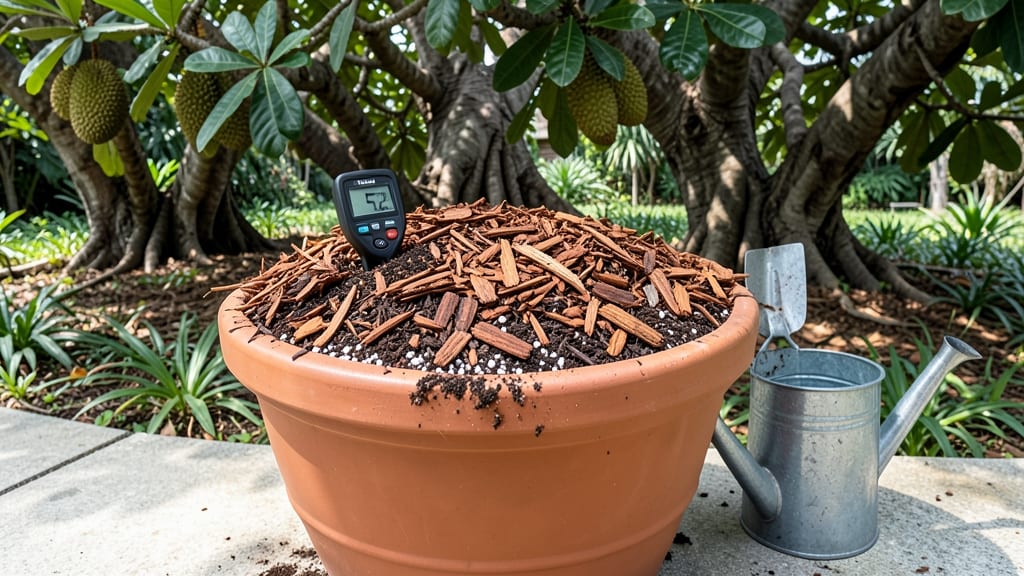
Understanding the durian soil requirements is critical for growing this tropical fruit—its roots thrive in rich, acidic loam with perfect drainage to fuel its towering growth 🌱.
If your durian’s growth stalls or fruit quality suffers, the problem likely starts underground. Unlike many fruits, durians demand a precise soil mix that balances moisture retention with aeration, or you’ll risk root rot or nutrient starvation.
In this guide, I’ll break down the exact pH range (4.5–6.0), organic matter ratios, and drainage tweaks needed to create the ideal environment—whether you’re planting in containers or ground soil.
You’ll also discover how to fix common mistakes like alkaline soil or compacted clay, plus a step-by-step DIY soil blend recipe tailored for your durian’s tropical roots.
Ideal soil pH and composition for durian trees: acidic loam breakdown
Durian trees demand precise soil conditions to thrive, and their acidic loam preference is non-negotiable. Native to Southeast Asia’s tropical rainforests, these trees require a well-aerated, nutrient-rich growing medium that mimics their natural habitat.
Without the right balance, you’ll see stunted growth, poor flowering, or even tree death—soil isn’t just dirt, it’s the lifeblood of your durian’s development.
The ideal pH range for durian trees sits between 4.5 and 6.0, firmly in the acidic spectrum. This acidity isn’t just a preference—it’s essential for unlocking micronutrient availability, particularly iron and manganese, which durians crave.
Test your soil before planting; most garden centers offer affordable pH test kits or lab analysis for accuracy. If your soil tests higher than 6.0, don’t panic—we’ll cover adjustments later.
A 60-30-10 loam texture—comprising 60% sand, 30% silt, and 10% clay—is the golden ratio for durian roots. This balance ensures optimal aeration while retaining enough moisture and nutrients. Sandy soils drain too quickly and need organic amendments like composted pine bark or coconut coir to hold onto humidity.
Conversely, clay-heavy soils can suffocate roots; mix in perlite or coarse sand to improve drainage. Think of durian soil as a sponge—it should hold water but never stay soggy.
Drainage is where many gardeners trip up. Durian trees hate waterlogged roots, which lead to root rot and fungal diseases. To test drainage, dig a hole, fill it with water, and time how long it takes to drain. If water pools after 30 minutes, amend your soil immediately.
Raised beds or containers with drainage holes are ideal for heavy clay soils. For sandy soils, incorporate 3–4 inches of organic mulch (like wood chips) to slow moisture loss and regulate temperature.
Organic matter is the secret weapon for durian soil health. Aim for 20–30% organic content, achieved through compost, well-rotted manure, or leaf mold. This isn’t just about feeding the tree—it’s about creating a thriving microbial ecosystem that breaks down nutrients into forms durian roots can absorb.
My go-to amendment is a mix of composted pine bark and coconut coir, which also helps maintain that critical acidic pH. Avoid fresh manure; it can burn roots and disrupt the pH balance.
If your soil tests above 6.0 pH, don’t despair—you can lower it safely with elemental sulfur or peat moss. For every 0.1 pH unit you need to drop, apply 1–2 pounds of sulfur per 100 square feet and water thoroughly.
Re-test in 2–3 months, as pH adjustment takes time. Over-liming is a common mistake; durians despise alkaline conditions, so avoid bone meal or wood ash, which raise pH. Instead, stick to acid-loving plant fertilizers labeled for azaleas or blueberries.
Regional adjustments matter. In tropical climates, durian trees benefit from shade cloth during peak sun hours to reduce soil evaporation, while in cooler subtropical zones, mulch heavily to insulate roots.
If you’re in a container, use a fast-draining potting mix with added perlite and replace it every 2–3 years to prevent nutrient depletion. Containers dry out quicker, so monitor moisture daily during hot spells.
Pro tip: Use a moisture meter to avoid guesswork—durian roots prefer consistently moist but never waterlogged conditions.
Let’s talk about nutrient density. Durian trees are heavy feeders, especially during flowering and fruiting seasons. A balanced 5-10-10 fertilizer (with micronutrients) applied every 4–6 weeks** keeps them thriving. However, over-fertilizing can burn roots
Common soil mistakes that stunt durian growth (and how to fix them)
Durian trees demand precise soil conditions to thrive, and even small mistakes can lead to stunted growth or poor fruit development. Alkaline soil is the #1 enemy—durian roots struggle to absorb nutrients when pH exceeds 6.5. Poor drainage causes root rot, while compacted clay suffocates roots.
Over-fertilizing with nitrogen-heavy mixes burns delicate roots. Let’s fix these issues before your durian tree gives up! 🌱
First, test your soil’s pH level—durian trees need acidic soil (4.5–6.0). If your soil tests higher, sulfur amendments are the quickest fix. Mix 1–2 pounds of elemental sulfur per 100 sq ft into the top 12 inches of soil.
Water thoroughly to activate the acidification process, which can take 4–6 weeks to lower pH. Re-test after 30 days to avoid over-acidifying. 💧
Next, tackle poor drainage by amending heavy clay soil with organic matter. Work in 3–4 inches of composted pine bark or coconut coir to improve aeration. For container-grown durians, use a well-draining mix (60% loam, 30% perlite, 10% compost).
Always include a drainage layer of gravel or broken pottery at the container’s base to prevent waterlogging. ✂️
Durian Soil Warning: Critical Errors to Avoid
Alkaline soil (pH >7.0) locks out nutrients, causing yellowing leaves and weak stems. Compacted clay restricts root growth, while over-fertilization burns roots and attracts pests. Poor drainage leads to root rot—always check for soggy soil after rain. Fix these issues before planting or within the first year to prevent irreversible damage.
If your durian’s soil feels hard or waterlogged, it’s time to aerate the roots. Use a garden fork to loosen soil around the root zone, creating channels for air and water. For severe compaction, add coarse sand or rice hulls to break up clay particles.
Mulch with wood chips or straw to retain moisture and prevent soil crusting. This mimics durian’s natural tropical forest floor, where organic debris enriches the soil. 🌿
Over-fertilizing is another silent killer. High-nitrogen fertilizers promote leafy growth at the expense of fruit. Switch to a balanced 5-10-10 or 8-3-9 formula and apply only during the growing season (spring–summer). Slow-release organic fertilizers, like composted manure or worm castings, feed roots steadily without burning.
Always water before and after applying fertilizer to dilute salts. ☀️
Finally, monitor your durian’s soil moisture—durian roots need consistent humidity but hate soggy conditions. Install a drip irrigation system to deliver water directly to the root zone, avoiding leaf wetting. In containers, check soil moisture daily; ground-planted durians need watering every 2–3 days during dry spells.
Adjust based on rainfall and seasonal heat. With these fixes, your durian will reward you with vibrant growth and sweet, spiky fruit! 🌳