
Light Requirements
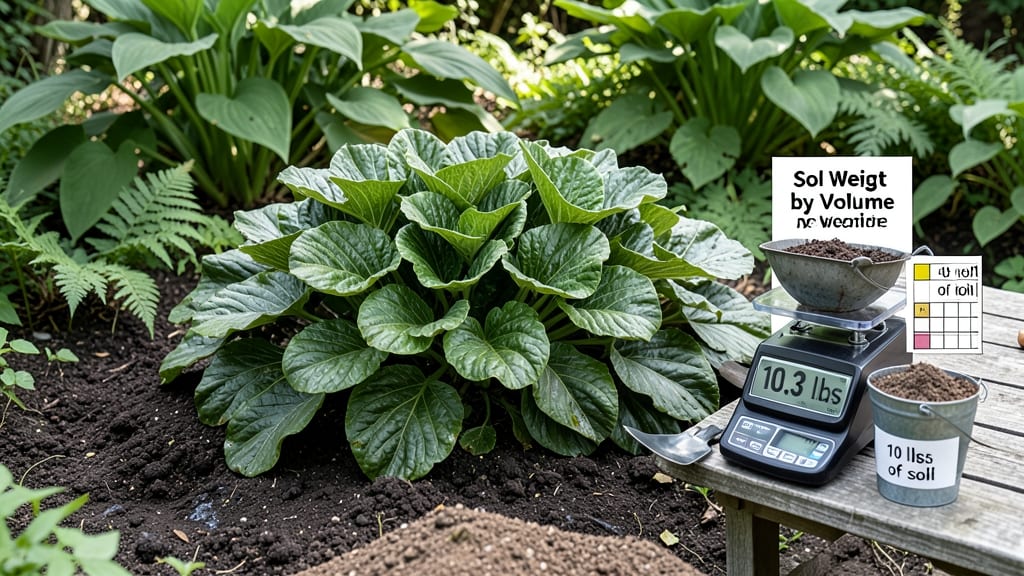
Soil weight varies between 60 to 120 pounds per cubic foot, depending on its composition—sandy soil typically weighs 60–80 lbs, loamy soil averages 80–100 lbs, and clay soil is heaviest at 100–120 lbs—while saturated moisture can increase weight by up to 30%.
Understanding soil weight isn't just about the numbers—it's about the science behind what's in your garden. 🌱 The weight shifts because of how tightly packed the particles are: sand has large, loose grains, so it's lighter, while clay's tiny particles cling together, making it denser.
Moisture plays a huge role too—when soil is saturated, water fills the gaps between particles, adding significant bulk. For example, a cubic foot of dry clay might weigh 110 lbs, but after heavy rain, it could jump to 140 lbs.
This matters in real-world gardening too. If you're building raised beds or calculating soil needs for erosion control, knowing the weight helps you plan for structural support and transportation. I always double-check moisture levels before moving heavy soil loads—wet soil is surprisingly heavier than you'd expect!
💡 In This Article
- Soil Weight Variations by Composition and Moisture Content
- Practical Applications: Estimating Soil Weight for Gardening Projects
Soil weight variations by composition and moisture content
The weight of soil isn't just about what's visible—it's a complex interplay between particle size, density, and hidden factors like porosity. Sandy soil, with its large, loosely packed grains, creates more air pockets, which is why it typically weighs 60–80 pounds per cubic foot.
Think of it like a bag of marbles: the bigger the pieces, the lighter the overall weight. In contrast, clay soil has tiny, tightly packed particles that leave minimal space for air, giving it a denser structure and a weight range of 100–120 pounds per cubic foot.
This difference is due to what scientists call "bulk density"—the mass of dry soil per unit volume.
Moisture is the wild card that can dramatically alter these numbers. When soil is saturated, water fills the gaps between particles, adding up to 30% more weight than dry soil.
For example, a cubic foot of dry loamy soil (typically 80–100 lbs) could swell to 110–130 lbs when fully waterlogged. This happens because water has a density of about 62.4 pounds per cubic foot, and it replaces the lighter air in the soil's pores.
The texture also changes—wet clay becomes sticky and heavy, while sandy soil feels damp but retains its lighter structure. 💧
Organic matter adds another layer of complexity. Compost or decomposed plant material is lighter than mineral soil, so gardens with high organic content (like raised beds) often have slightly lower bulk density.
For instance, a mix of 50% compost and 50% loamy soil might weigh closer to 70–90 pounds per cubic foot instead of the standard 80–100 lbs. This is why topsoil—rich in organic material—is often lighter than subsoil, which is more mineral-heavy. The key takeaway?
Soil weight isn't static; it shifts with composition, moisture, and even compaction from foot traffic or machinery.
Here’s how these factors play out in real-world scenarios: A 10-foot-long raised bed filled with sandy soil might weigh around 600–800 lbs when dry, but after a heavy rain, that same bed could tip the scales at 800–1,000 lbs.
The difference isn’t just about the water—it’s about how the soil’s structure changes under load. Clay soil, being heavier, can exert up to 20% more pressure on container walls or garden beds, which is why sturdy materials (like cedar or treated lumber) are recommended for heavy clay gardens. 🏗️
For those working with large volumes, like landscapers or farmers, understanding these variations is critical. A 1-yard (27 cubic feet) truckload of dry clay soil could weigh 2,700–3,240 lbs, but if it’s wet, that load jumps to 3,500–4,000 lbs.
This isn’t just about guesswork—it’s about safety and efficiency. Overloading a wheelbarrow or misjudging a truck’s capacity can lead to accidents, which is why professionals often use moisture meters or simple weight calculations to adjust their plans.
Even small-scale gardeners can use this knowledge to their advantage. If you’re filling a 5-gallon container (about 0.07 cubic feet), dry sandy soil would weigh roughly 4–6 lbs, while clay soil would be 7–9 lbs.
But after watering, those numbers climb to 5–8 lbs and 9–12 lbs, respectively. This precision helps when designing lightweight planters or calculating how much soil to mix for seed starting. The devil’s in the details—and in this case, the details are hiding right under your feet. 🌿