
How To
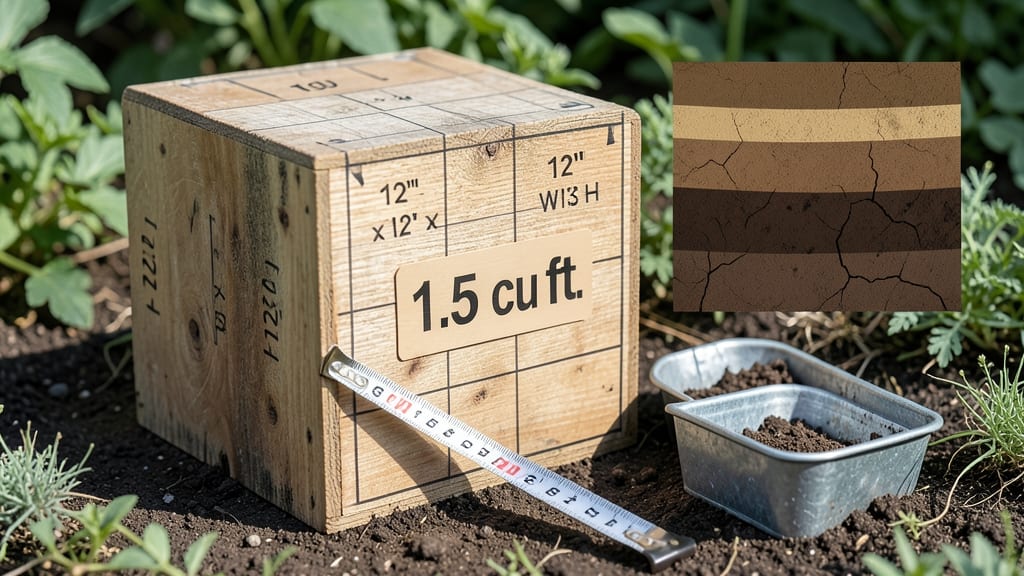
That 1.5 cubic feet bag of soil you just bought covers far less area than you might think—about 1 square foot when spread 1 inch deep. 🌱 Honestly, I’ve wasted soil (and money) by guessing, but this simple math prevents that.
Whether you're mulching, planting beds, or topping off garden soil, knowing the exact coverage means fewer trips to the store and no surprises mid-project.
Here’s the formula: Divide the bag’s cubic feet by your desired depth in feet (e.g., 1.5 cubic feet ÷ 0.083 feet = 18 square feet for a 1-inch layer).
Grab a ruler or measuring tape to check depth—1 inch is standard for mulch, but deeper layers (like 3 inches for planting beds) mean fewer square feet per bag. Pro tip: Mark your work area with stakes or spray paint to avoid over- or under-applying.
For a 10x10-foot bed at 1-inch depth, you’ll need 100 square feet of coverage, meaning 100 bags of 1.5 cubic feet soil. That’s a lot, so plan ahead!
The payoff? A uniform, professional-looking garden bed without gaps or wasted soil. Plus, you’ll avoid the panic of running out mid-project—trust me, I’ve been there.
Need to adjust for deeper layers? No problem. For 3-inch depth, divide by 0.25 feet (3 inches) instead. And if you’re mixing soil with compost or mulch, account for bulk—1 cubic foot of loose mulch covers about 100 square feet at 1 inch deep.
Keep it simple, measure twice, and your garden will thank you.
📚 In This Guide
- What you need
- Instructions
- Tips and common mistakes
- Wrapping up and next steps
What you need
- ● Soil or growing medium: 1.5 cubic feet (or ~42.48 cubic inches) of high-quality topsoil, compost, or potting mix. Pro tip: For gardens, opt for loamy soil (a mix of sand, silt, and clay). For containers, use lightweight potting mix.
- ● Measuring tape: A 16-foot tape measure (or longer) for accuracy in calculating square footage.
- ● Wheelbarrow or shovel: A sturdy wheelbarrow (2-3 cubic feet capacity) or a round-point shovel for moving soil efficiently.
- ● Leveling tool: A garden rake or hand level to smooth out the soil surface evenly.
- ● Calculating tools: Notepad + pen or a calculator (for manual conversions) or a soil calculator app (like Gardenate or Soil Moisture).
- ● Protective gear: Gloves, knee pads, and closed-toe shoes for safety and comfort.
- ● Soil amendment: Compost, perlite, or vermiculite to improve drainage or fertility.
- ● Mulch: Straw, wood chips, or shredded leaves to retain moisture and suppress weeds.
- ● Edging tools: Plastic or metal landscape edging to define garden beds neatly.
- ● Watering can or hose: For post-installation hydration (especially for seedlings or new plants).
- ● Soil moisture meter: To monitor moisture levels if growing plants.
- ● Know the depth of soil coverage needed (e.g., 1 inch, 2 inches, etc.).
- ● Measure the area’s dimensions (length × width) in feet.
- ● Check local weather forecasts—avoid working in extreme heat or rain.
- ● Clear the area of rocks, debris, or weeds before spreading soil.
How to calculate 1.5 cubic feet of soil coverage for your garden
This is the math every landscaper uses to avoid overbuying or running short—simple once you know the trick.
📏 Step 1: Understand the Basic Conversion Formula
The key is remembering that 1 cubic foot of soil covers 1 square foot at a depth of 1 inch. This is your starting point. For 1.5 cubic feet, you're essentially working with 1.5 times that volume. The deeper you spread the soil, the fewer square feet it will cover.
Think of it like filling a cake pan: if you pour batter into a 1-inch-deep pan, it covers more area than if you pour the same batter into a 2-inch-deep pan. Soil works the same way. A 1.5 cubic feet bag will cover 15 square feet at 1 inch deep, but only 7.5 square feet at 2 inches deep.
📐 Step 2: Apply the Formula to Your Project Depth
First, decide how deep you want to spread the soil. Common depths for garden beds are 1 inch, 2 inches, or 3 inches. Divide 1.5 cubic feet by your chosen depth (in feet) to find the square footage coverage.
For example:
- 1-inch depth: 1.5 ÷ (1/12) = 18 square feet (since 1 inch = 1/12 of a foot)
- 2-inch depth: 1.5 ÷ (2/12) = 9 square feet
- 3-inch depth: 1.5 ÷ (3/12) = 6 square feet
Here’s the trick: multiply 1.5 by 12, then divide by your depth in inches. This simplifies the math.
✏️ Step 3: Adjust for Real-World Conditions
Soil doesn’t spread perfectly flat in real life. Always add 10-20% extra to account for uneven terrain, compaction, or settling. For example, if you need 10 square feet at 2 inches, calculate 12-14 square feet of coverage to ensure you have enough.
I also recommend test-spreading a small section first. Scoop a handful of soil onto a marked 1-square-foot area and spread it to your desired depth. Compare the volume used to your total bag size—this gives you a visual reference for the rest of your project.
📊 Step 4: Scale Up for Larger Projects
If you’re working with multiple bags (e.g., 4 × 1.5 cubic feet bags = 6 cubic feet total), multiply your coverage calculations by 4. For instance, 6 cubic feet at 2 inches deep covers 36 square feet (6 ÷ (2/12) × 1.2 for extra).
Use graph paper to sketch your garden layout. Divide the area into 10×10-foot sections for easy math. Label each section with its depth requirement, then tally the total cubic feet needed. This prevents surprises at the nursery.
⚠️ Step 5: Avoid Common Mistakes
Don’t assume all soil bags are the same density. Topsoil, compost, and potting mix vary in weight and settling. A 1.5 cubic feet bag of compost may spread differently than the same volume of topsoil because compost is lighter and fluffier.
Also, don’t skip the depth measurement. Use a 4-inch level or straight board to check consistency. Uneven depths lead to poor drainage or wasted soil. If your garden has slopes, break the area into level sections and calculate each separately.
Tips & tricks for perfect soil coverage calculations
Here's what nobody tells you about making these calculations foolproof in real-world gardening.
Depth Precision Pays Off: The 1-inch, 2-inch, and 3-inch depth examples in Step 2 are your baseline, but real gardens rarely have perfect consistency. Use a 4-inch level or straight board to verify depth after spreading. I've seen projects where one side was 1.5 inches deep while the other was only 0.75 inches—this inconsistency wastes soil and creates uneven plant growth. Always measure after spreading, not before.
Density Matters More Than You Think: Step 5 warns about different soil types, but here's the deeper truth: compost spreads about 20-30% wider than topsoil because it's lighter and more porous. For accurate calculations, weigh your soil bags first—most bags marked "1.5 cubic feet" actually contain 1.2-1.4 cubic feet when packed. When in doubt, buy an extra bag for compost projects.
Visual Reference Shortcut: For quick estimates, remember this mental trick: 1 cubic foot ≈ 12 square feet at 1 inch deep. So 1.5 cubic feet becomes 18 square feet at that depth. But here's the pro move—divide your desired depth in inches into 18 to get instant coverage. For 2 inches: 18 ÷ 2 = 9 square feet. For 3 inches: 18 ÷ 3 = 6 square feet. This works because 1.5 × 12 = 18, and you're just adjusting for depth.
Slope Strategy: When working on sloped gardens (Step 5), divide the area into contour lines rather than straight sections. Use a garden hose to mark level curves, then calculate each contour separately. I've saved entire bags of soil by avoiding the common mistake of treating slopes as flat surfaces—what looks like 10 square feet might actually be 15 when you account for the angle.
Pro Tips for 1.5 Cubic Feet Soil Covers How Many Square Feet
- Here's what nobody tells you about making these calculations foolproof in real-world gardening.
- Depth Precision Pays Off: The 1-inch, 2-inch, and 3-inch depth examples in Step 2 are your baseline, but real gardens rarely have perfect consistency.
- Density Matters More Than You Think: Step 5 warns about different soil types, but here's the deeper truth: compost spreads about 20-30% wider than topsoil because it's lighter and more porous.
Frequently asked questions
Got questions about converting cubic feet of soil to square foot coverage?
You’re not alone! Here are some of the most common questions—and straightforward answers—to help you plan like a pro.
1. How do I calculate the square footage coverage for 1.5 cubic feet of soil?
If you’re spreading soil 1 inch deep, 1.5 cubic feet covers about 1.5 square feet. For deeper layers (e.g., 2 inches), divide the cubic feet by the depth in feet (e.g., 1.5 ÷ 0.167 = ~9 sq ft for 2"). Use a conversion calculator for precision!
2. Can I use 1.5 cubic feet of soil for a raised garden bed?
It depends on the bed’s size! For a small bed (e.g., 2’x2’), 1.5 cubic feet is enough for a 1-inch layer. For deeper beds (6+ inches), you’ll need 3–5 cubic feet per square foot. Pre-mix soil with compost for better drainage and nutrient retention. Pro tip: Buy in bulk to save costs!
3. How long does it take to spread 1.5 cubic feet of soil evenly?
For a beginner, spreading 1.5 cubic feet over 1.5 sq ft (1-inch deep) takes 5–10 minutes with a rake. For larger areas, use a shovel or wheelbarrow to speed up the process. Time-saver: Work in small sections to avoid compaction.
4. What if I don’t have enough soil? Can I use alternatives?
Yes! Mix 1.5 cubic feet of topsoil with:
- Compost (½ cubic foot) for nutrients
- Peat moss (½ cubic foot) for moisture retention
- Sand/gravel (¼ cubic foot) for drainage
5. Why does my soil coverage seem uneven after spreading?
Uneven coverage usually means clumping or inconsistent depth. Fix it by:
- Fluffing soil before spreading to break up clods
- Using a level to check depth (aim for ±¼ inch)
- Avoiding wet soil—it compacts easily
Wrapping up and next steps
Understanding how 1.5 cubic feet of soil translates to square footage coverage is a game-changer for gardening, landscaping, or DIY projects! 🌱 Whether you're planning a raised bed, mulching, or filling a container, knowing this conversion helps you estimate materials with confidence.
Now that you’ve mastered the math, put your knowledge into action—start measuring your space and calculate exactly how much soil you’ll need for your next project!
🚀 Ready to Dig In?
Grab your tape measure, sketch a quick design, and transform your space with the right soil coverage. Happy planting! 🌿