
Landscaping
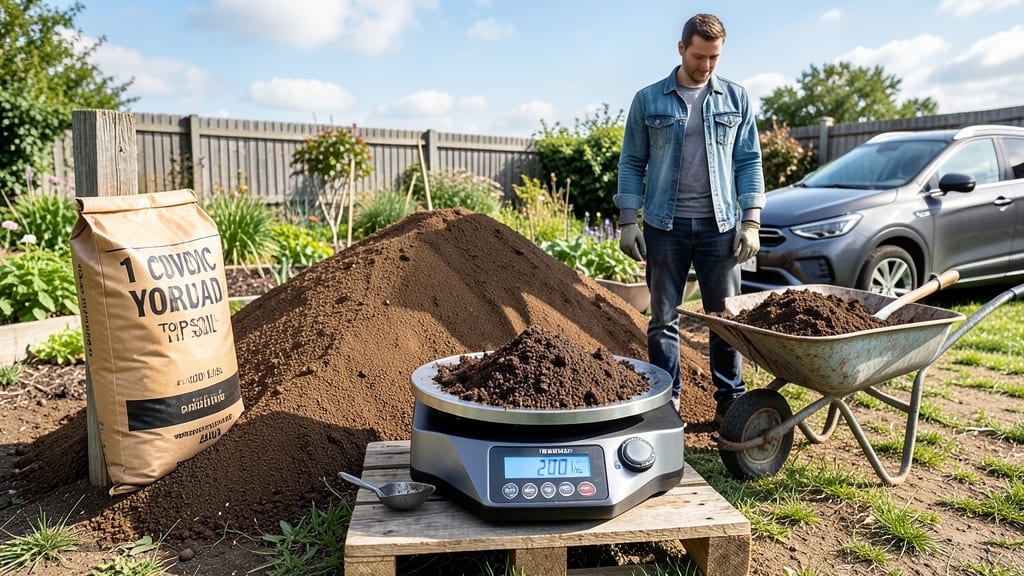
A yard of topsoil weighs between 1,700 and 2,200 pounds, depending on how wet it is, how tightly packed it is, and what's mixed into it. Dry, loose soil sits at the lighter end, while saturated or compressed soil can push closer to 2,200 pounds or more.
A yard of topsoil's weight isn't just about volume—it's a science of moisture and density. Moisture content is the biggest factor: add water, and you're adding 10-20 pounds per cubic foot to the total. Compaction also plays a role—tightly packed soil may weigh more per cubic yard because the same mass occupies less space.
For example, a freshly tilled garden bed might weigh 1,800 pounds, while the same soil after a heavy rain could jump to 2,100 pounds. Understanding this helps when planning deliveries or digging projects. 🔥
This variation matters in real-world landscaping. If you're filling a 4-foot-deep raised bed, you'll need to calculate based on whether your soil is dry or damp. Pro tip: always ask suppliers about moisture levels when ordering—it can save you from overestimating or struggling with unexpected weight during transport.
The difference between 1,700 and 2,200 pounds isn't just numbers; it's the difference between a manageable load and one that requires heavy equipment.
💡 In This Article
- Factors Affecting Topsoil Weight: Moisture, Density, and Composition
- Calculating Topsoil Weight for Landscaping Projects
Factors affecting topsoil weight: moisture, density, and composition
Moisture content is the single biggest factor in topsoil weight variations. Water weighs about 8.34 pounds per gallon, and topsoil can hold 20-50% of its volume in water depending on conditions.
For example, a cubic yard of dry topsoil might weigh 1,700 pounds, but after a heavy rain, that same volume could swell to 2,100 pounds as water fills the pores between soil particles. This is why freshly tilled soil often feels lighter—it's lost moisture through evaporation and aeration.
Compaction plays a different but equally important role. When soil is tightly packed, the same mass occupies less space, increasing its density. A compacted cubic yard might measure only 26-27 cubic feet instead of the standard 27 cubic feet, making it feel heavier per unit volume.
This is why construction sites often use compacted soil for foundations—it provides stability but requires more weight-bearing capacity from equipment. The key difference is that compaction doesn't change the total mass, just how that mass is distributed in space.
Soil composition dramatically alters weight too. Sandy soils, with larger particles and more air space, typically weigh 1,500-1,800 pounds per yard when dry. In contrast, clay-heavy soils can reach 2,000-2,300 pounds due to their finer particles and higher water retention.
Organic matter adds another layer—compost-amended topsoil might weigh slightly less (1,600-1,900 pounds) because organic materials are less dense than minerals, but they hold more water, increasing weight when wet. This is why bagged topsoil often lists "dry weight" on packaging—it's accounting for these natural variations.
Temperature also sneaks into the equation. Cooler soils hold more moisture in liquid form, while warmer soils may have some water vapor, which is lighter. This seasonal variation means winter deliveries often feel heavier than summer ones, even if the volume appears identical.
For precise calculations, professionals use a soil moisture meter to measure volumetric water content, which can adjust weight estimates by up to 15% depending on conditions. This level of detail matters for large-scale projects where even small weight miscalculations can affect equipment needs.
Here's what happens under the microscope: Soil particles arrange themselves in clusters with air and water filling the gaps. When you add water, those gaps fill with 1.0 grams per cubic centimeter of liquid (water's density), replacing the 0.0012 grams per cubic centimeter of air.
That's a 833-fold increase in the weight of that space! This is why a 10% moisture increase can add 100-150 pounds to a cubic yard of topsoil. Understanding this helps explain why freshly watered garden beds feel dramatically heavier than dry ones.
For practical purposes, most landscapers use a rule of thumb: assume 2,000 pounds per cubic yard for general planning, then adjust based on local conditions. In arid climates, you might start at 1,800 pounds, while humid regions could require planning for 2,200 pounds.
This buffer accounts for the natural variability while keeping projects on track. The science behind these numbers shows why topsoil weight isn't just about volume—it's a dynamic interplay of physics and environmental factors.