
Light Requirements
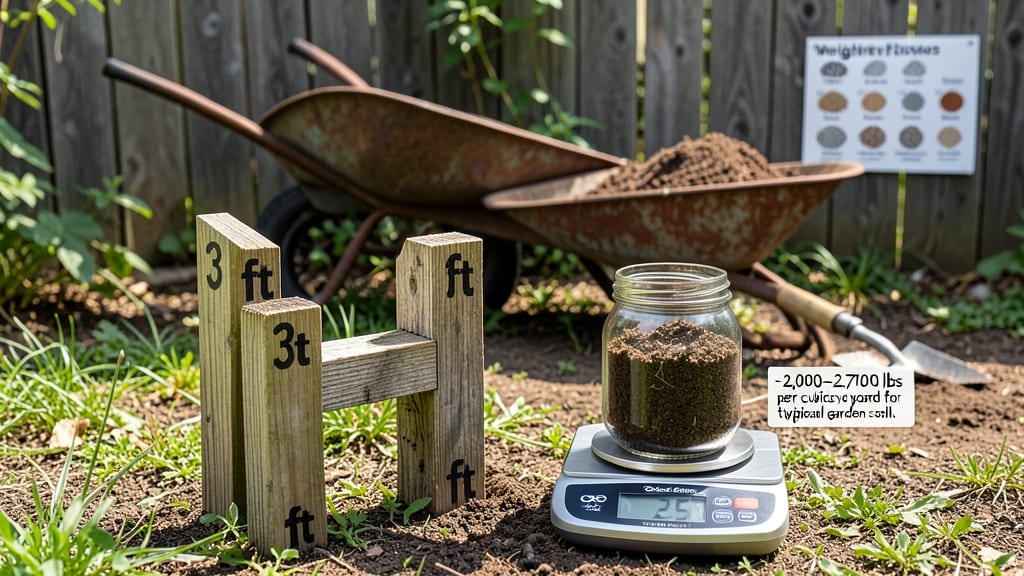
The weight of soil per cubic yard varies significantly by type: loamy soil typically weighs 2,400–2,700 pounds, sandy soil 2,200–2,500 pounds, clay soil 2,700–3,000 pounds, and peat moss 1,000–1,500 pounds—moisture content can add an extra 200–500+ pounds to the total.
The weight differences come down to particle size and moisture retention.
Clay soil packs the most weight because its tiny particles compress tightly, while peat moss stays light due to its high organic content and air pockets. 💫 Moisture plays a huge role—wet soil can weigh nearly double what dry soil does, which is why gardeners often account for seasonal changes when calculating loads for projects like raised beds or pathways.
For practical applications, I recommend using a moisture meter to adjust your estimates. A standard wheelbarrow holds about 2 cubic feet of soil, so you can multiply that by 27 to estimate cubic yards—but always round up for safety.
Many underestimate because they forget how much heavier compacted soil becomes after rain or irrigation.
💡 In This Article
- Soil Density Factors Affecting Cubic Yard Weight
- Practical Tips for Estimating Soil Weight in Gardening Projects
Soil density factors affecting cubic yard weight
Soil weight per cubic yard isn't just about the type of particles—it's a complex interplay of particle size, moisture, and how tightly they're packed.
Clay particles, for example, are microscopic (0.002 mm diameter), allowing them to pack densely with minimal air space, which is why clay soil reaches 2,700-3,000 pounds per cubic yard. Sandy soil, with its larger particles (0.05-2 mm), creates more air pockets, reducing weight to 2,200-2,500 pounds.
The difference? Clay holds 30-50% more water by volume than sand, adding significant weight.
Moisture is the wild card—it can increase soil weight by 20-50% depending on saturation. A cubic yard of dry loam weighs 2,400 pounds, but after heavy rain, that same volume might hit 3,000 pounds as water fills the pore spaces.
The science here involves capillary action: clay's tiny particles create strong molecular bonds with water, while sand's larger particles let water drain quickly. This is why clay feels heavier when wet—it's not just water weight, but the water's chemical interaction with the soil matrix.
Organic matter plays a hidden role too. Peat moss, with its 90% organic content, weighs only 1,000-1,500 pounds because its fibrous structure traps air rather than water. Compare this to compost-amended soil, which can weigh 10-20% more than mineral soil due to decomposed organic material's higher density.
The key factor here is decomposition stage: fresh compost is lighter, while aged compost becomes denser as microbial activity breaks down materials into finer particles.
Compaction adds another layer. Foot traffic or machinery can reduce air space by 20-30%, increasing weight by 15-25% for the same volume. This is why construction sites often specify "compacted fill"—they're accounting for this density increase.
Even in gardens, walking on raised beds can compact the soil over time, making future weight estimates inaccurate if you don't account for this settling factor.
Temperature matters subtly too. Cold soil holds more water in ice crystals, increasing winter weight by 5-10%** compared to summer. The freeze-thaw cycle also creates larger particles through frost heaving, which can temporarily reduce density.
For precise calculations, always measure soil weight during the season you'll be working—spring's moisture levels won't match summer's dry conditions.
Here's a quick reference for common soil types and their weight ranges:
- Clay soil: 2,700-3,000 lbs (high moisture retention, tiny particles)
- Loamy soil: 2,400-2,700 lbs (balanced particle size, moderate moisture)
- Sandy soil: 2,200-2,500 lbs (large particles, poor moisture retention)
- Peat moss: 1,000-1,500 lbs (organic, high air content)
- Silt: 2,500-2,800 lbs (medium particles, moderate moisture)
The takeaway? Soil weight isn't static—it's a dynamic property that changes with seasons, compaction, and organic content. For accurate estimates, always measure moisture levels and consider your project's specific conditions. 💫