
Light Requirements
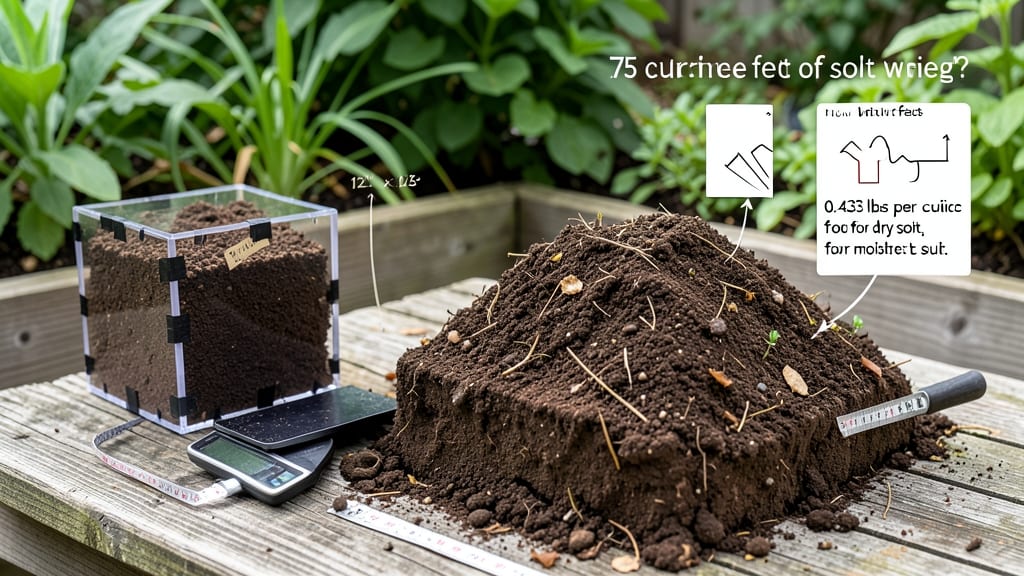
To determine how much 0.75 cubic feet of soil weighs, expect between 15 to 30 pounds, depending on soil type—sandy soil leans toward 15–20 lbs, loamy soil averages 20–25 lbs, and clay-heavy soil can reach 25–30 lbs—while moisture levels add 5–10% extra weight.
Soil weight varies dramatically based on its composition and moisture content. Sandy soils are lighter because their large particles create more air pockets, while clay soils pack tightly, increasing density. 💧 The moisture factor is critical—wet soil can weigh up to 10% more than dry soil of the same volume.
For example, a raised garden bed filled with loamy soil might need adjustments in structural support depending on whether the soil is freshly watered or bone-dry.
Understanding these variations helps with everything from calculating material needs for landscaping projects to ensuring proper drainage in containers. Many gardeners use a simple formula: multiply the cubic feet by 1.5 for sandy soil or 2.5 for clay-heavy soil to estimate weight—then add 10% if the soil is moist.
💡 In This Article
- Soil Density Factors Affecting Weight per Cubic Foot
- Practical Soil Weight Estimates for Gardening Projects
Soil density factors affecting weight per cubic foot
Soil weight varies because of its particle composition—sand, silt, and clay each contribute differently. Sandy soil has large particles with high porosity, creating air gaps that reduce density.
A cubic foot of dry sand typically weighs 90-100 pounds, but its loose structure means 0.75 cubic feet of sandy soil often measures 15-20 pounds—lighter than other types. 🌱 Clay particles are tiny and tightly packed, eliminating air spaces and increasing density to 110-130 pounds per cubic foot, making 0.75 cubic feet of clay-heavy soil weigh 25-30 pounds.
The organic matter content also plays a role—compost or decomposed plant material adds bulk but reduces overall weight. For example, a mix of 50% loam and 50% compost might weigh 18-22 pounds for 0.75 cubic feet, lighter than pure loam.
Compaction further alters weight: tamped-down soil loses air pockets, increasing density by 10-20%. This is why garden beds feel heavier after rain or foot traffic. 💧
Moisture is the wild card—water fills those air pockets, adding 5-10% extra weight instantly. A dry loamy soil sample might weigh 22 pounds, but after saturation, it could hit 24-25 pounds. This variability is why contractors use bulk density tests (measuring weight per unit volume) before large projects.
For instance, a 10% moisture increase in clay soil can add 2-3 pounds to 0.75 cubic feet.
Porosity—the percentage of air and water a soil can hold—directly impacts weight. Sandy soils have 40-50% porosity, while clay soils have 30-40%. This means 0.75 cubic feet of sandy soil holds less water by volume, keeping its weight lower.
In contrast, clay soils retain more moisture, making them heavier even when "dry" to the touch. Think of it like packing sand vs. clay in a jar—one stays loose, the other becomes dense. 🧱
Real-world example: A 5-gallon bucket (≈0.23 cubic feet) of dry sand weighs 25-30 pounds, while the same bucket of clay weighs 35-40 pounds.
Scaling up, 0.75 cubic feet (≈3.25 buckets) of clay would weigh 110-130 pounds per cubic foot, but the 0.75 cubic feet portion aligns with the 25-30 pound range due to volume reduction.
This math helps gardeners estimate how much soil to lift or transport for projects like raised beds. 🌿