
Light Requirements
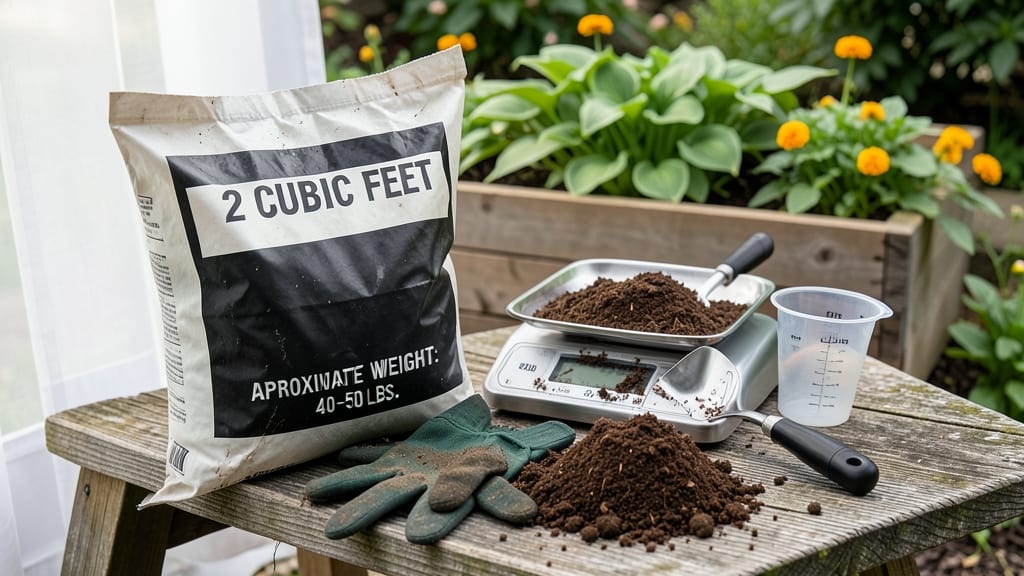
Two cubic feet of potting soil weighs between 20 to 40 pounds, with the exact weight depending on the mix composition—peat-heavy mixes stay closer to 20 lbs, while compost or mineral-rich blends can exceed 40 lbs when damp.
Understanding this weight range helps you plan for container gardening or shipping projects. 🌱 The biggest factor is moisture—dry soil can weigh 10-15% less than when freshly watered.
For example, a standard 5-gallon container holds about 0.35 cubic feet, so you'd need roughly 15-30 lbs of mix depending on the type. If you're building raised beds, heavier mixes provide better stability but require stronger supports.
Most gardeners overlook how particle size affects weight—coarse mixes with perlite or bark chips stay lighter, while fine-textured compost blends pack more densely. This matters when calculating how much soil you'll need for large projects or when transporting bags to your garden space.
💡 In This Article
- Potting Soil Density Factors Explained
- Choosing Potting Mixes for Weight-Sensitive Projects
Potting soil density factors explained
Potting soil weight varies dramatically because of its composition—organic materials like peat moss and compost pack differently than inorganic components like perlite or vermiculite.
Peat moss, for example, has a density of about 10-12 pounds per cubic foot when dry, but it absorbs up to 4-5 times its weight in water, which explains why peat-heavy mixes can jump from 18 lbs to 25 lbs when moist.
In contrast, perlite (a volcanic glass) weighs just 4-8 pounds per cubic foot due to its porous, air-filled structure, making it a key lightweight additive.
The particle size plays a crucial role too. Fine-textured compost blends (with particles 1/4-inch or smaller) pack tightly, creating a denser mix that can reach 30-40 lbs per 2 cu ft. Coarse mixes with bark chips or sand, however, stay lighter—often 15-25 lbs—because air pockets reduce overall density.
This is why a 50% compost/50% perlite mix might weigh 22 lbs dry but 30 lbs when watered, while a 100% peat mix could swing from 18 lbs dry to 28 lbs wet. 🌱
Moisture content is the wild card—water alone adds 8.34 lbs per gallon, so a 2 cu ft bag (≈16 gallons capacity) can gain 10-15 lbs just from hydration. Garden soil, by comparison, typically weighs 60-100 lbs per 2 cu ft because it contains heavier clay and mineral particles.
Potting mixes are engineered to be 30-60% lighter to prevent root suffocation in containers, but this also means your 10-gallon pots (≈1.3 cu ft) might hold only 13-26 lbs of mix—far less than you'd expect from garden dirt.
Here’s a quick breakdown of how common additives affect weight:
- Peat moss: 10-12 lbs/cu ft dry, 30-40 lbs/cu ft when saturated
- Compost: 20-30 lbs/cu ft (varies by organic matter)
- Perlite: 4-8 lbs/cu ft (stays lightweight even when wet)
- Vermiculite: 6-10 lbs/cu ft (absorbs water but retains air)
- Sand: 80-100 lbs/cu ft (heaviest inorganic option)
For container gardening, this means a 7-gallon pot (≈0.85 cu ft) filled with a peat-perlite mix might hold just 8-12 lbs, while the same pot with a compost-heavy blend could reach 15-20 lbs.
The difference isn’t just about weight—it’s about drainage and aeration. Heavier mixes drain slower, which is ideal for moisture-loving plants like ferns, while lighter mixes suit succulents or cacti that need quick-draining soil. ✨
Pro tip: If you’re shipping potting soil, account for the 20-30% weight increase from moisture. A 40-lb bag could become 50+ lbs after watering, which matters for structural supports in raised beds or self-watering planters.
Always check the mix’s moisture retention label—some "lightweight" blends are marketed for containers but still pack a surprising punch when damp.