
Trees
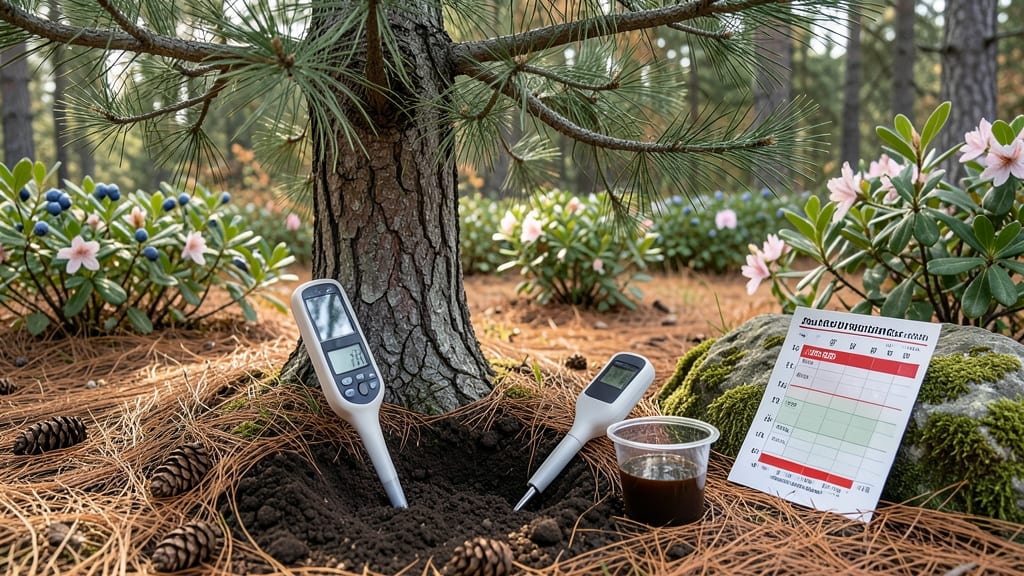
Pine trees do make soil acidic by naturally lowering pH levels as their needles decompose, releasing organic acids that create an acidic environment ideal for their growth and inhibiting competing plants.
This happens because pine needles contain high levels of tannins and phenolic compounds that break down slowly in the soil. 🌲 Over time, these compounds release hydrogen ions, which gradually reduce the soil's pH—sometimes dropping it below 5.0 in heavily wooded areas.
The result is a soil environment that favors pine trees while suppressing many broadleaf plants and grasses that prefer neutral or alkaline conditions. If you're gardening near pine trees, you'll need to monitor soil pH regularly and consider lime applications for plants that don't thrive in acidic soil.
What's fascinating is how this natural process creates an ecosystem where only certain plants can survive. The acidic soil becomes a competitive advantage for pine trees, allowing them to dominate their habitat while creating challenges for gardeners trying to grow non-acid-tolerant plants nearby.
Understanding this mechanism helps explain why pine forests often appear so uniform in their plant composition.
💡 In This Article
- How Pine Needles Acidify Soil Over Time
- Managing Soil pH When Planting Near Pine Trees
How pine needles acidify soil Over time
Pine needles contain high concentrations of tannins and phenolic compounds—natural chemicals that act like slow-release acidifiers. When needles fall and decompose, these compounds break down into simpler organic acids (like humic and fulvic acids) that release hydrogen ions into the soil.
This biochemical process is similar to how vinegar (acetic acid) lowers pH when added to water, but far more gradual. 🌲 Over 5-10 years, a thick layer of pine needles can reduce soil pH from a neutral 7.0 to as low as 3.5-4.5, creating conditions ideal for pine trees but inhospitable for many other plants.
The acidification happens in stages: first, the needles form a thick mulch that blocks sunlight and slows decomposition, then microbial activity gradually breaks them down into simpler compounds.
Studies show that pine forest floors often have 2-3 inches of undecomposed needles, creating an acidic barrier that prevents many seeds from germinating.
The tannins also bind with minerals like calcium and magnesium, making them less available to competing plants while pine trees adapt to absorb nutrients efficiently in acidic conditions.
This natural acidification explains why pine forests often appear so uniform. The low pH inhibits broadleaf plants and grasses that prefer neutral or alkaline soil, while pine seedlings thrive in the acidic environment.
For example, blueberries and rhododendrons—both acid-loving plants—often grow naturally under pine trees, while vegetables like tomatoes or lettuce struggle to establish. The soil's acidity also affects microbial communities, favoring fungi that help pine roots absorb nutrients over bacteria that benefit other plants.
What's surprising is how persistent this effect remains. Even after pine trees are removed, the soil can stay acidic for decades because the organic acids bind tightly to soil particles.
Gardeners often find that simply clearing pine needles isn't enough to restore neutral pH—sometimes requiring lime applications every 2-3 years to raise the pH back to 6.0-7.0 for non-acid-tolerant plants. The process demonstrates nature's way of creating specialized ecosystems where only certain species can survive.
The biochemical mechanism behind this involves two key reactions: the hydrolysis of tannins (which releases hydrogen ions) and the oxidation of phenolic compounds (which produces more acidic byproducts).
These reactions are accelerated by moisture and temperature fluctuations, which is why pine forests in wetter climates often have more acidic soils than those in drier regions. The result is a self-perpetuating cycle where pine trees maintain their dominance through both physical shading and chemical soil modification.
Understanding this process helps explain why pine trees often appear in pure stands. The acidic soil they create becomes a competitive advantage, suppressing other plant species while creating ideal conditions for pine regeneration.
For gardeners, this means that planting near mature pine trees requires careful soil management—whether through acid-loving plants, raised beds with neutral soil, or regular pH testing to maintain a healthy growing environment. 🌱