
How To
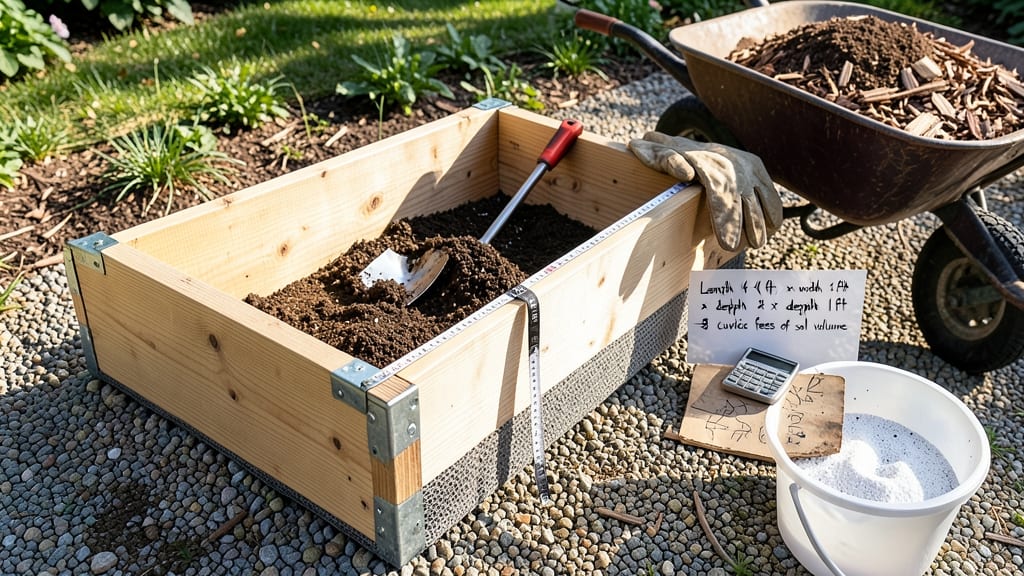
Calculating raised bed soil is the first step to avoiding a soil shortage that leaves you scrambling at the bag store. 🌱 I learned this the hard way—my first raised bed ended up with only 6 inches of soil instead of the planned 12, and my tomatoes struggled all season.
The right amount means deeper roots, healthier plants, and no wasted money on extra bags.
You only need three things: your bed’s length, width, and desired soil depth. Multiply them together (length × width × depth) to get cubic feet, then convert to cubic yards for bulk soil orders.
A 4×8-foot bed with 12 inches of soil needs about 1.3 cubic yards—that’s roughly 12 bags of topsoil. Pro tip: Mix in compost to improve drainage and fertility without needing more volume.
With the right soil mix, your plants will reward you with vibrant green growth and bountiful harvests. The key is testing soil depth before filling and adjusting for compaction (soil settles about 25%). I’ve saved hundreds by calculating precisely—no more overbuying or running out mid-project.
This method works for any raised bed size, from small herb gardens to full-size vegetable plots. Whether you’re using topsoil, compost, or a custom blend, the math stays the same. Ready to get your measurements right the first time?
📚 In This Guide
- What you need
- Instructions
- Tips and common mistakes
- Wrapping up and next steps
What you need
- ● Soil components: Topsoil (20-30% of mix) – 1 cubic foot per 1 sq. ft. of bed depth
- ● Compost (20-30%) – Organic matter for nutrients; use well-aged, weed-free compost
- ● Peat moss or coconut coir (20%) – Retains moisture; opt for sustainable coir if possible
- ● Perlite or vermiculite (10-15%) – Improves aeration; 1 part per 5 parts soil
- ● Sand (10-15%) – Coarse sand for drainage; avoid fine dust
- ● Tools: Wheelbarrow or large bucket (for mixing)
- ● Garden shovel or spade (for layering)
- ● Measuring tape (to confirm bed dimensions)
- ● Calculating tool (notebook or app for cubic feet)
- ● Gloves & dust mask (for handling soil)
- ● Biochar (5%) – Boosts microbial life; mix 1 part per 10 parts soil
- ● Worm castings (10%) – Natural fertilizer; great for veggies
- ● Landscape fabric (under bed) – Prevents weeds; cut to fit bed base
- ● pH test kit – Check soil acidity (ideal: 6.0–7.0 for most plants)
- ● Watering can or hose – For post-mix hydration
How to calculate soil for a raised bed without guessing
No more eyeballing soil volume—this method gives you exact cubic feet for any bed size.
📏 Step 1: Measure Your Raised Bed Dimensions
Grab a tape measure and record the bed's length × width × depth in feet. For example, a 4-foot-long bed that's 2 feet wide and filled to 10 inches deep isn't 8 cubic feet—you'll need to convert that depth to feet first. Divide 10 inches by 12 to get 0.83 feet. Multiply all three numbers: 4 × 2 × 0.83 = 6.64 cubic feet of soil needed.
Here's the thing—most raised beds aren't perfectly rectangular. If yours has rounded corners, measure the straight sections separately, add them, then divide by 2 for an average. I always round up to the nearest quarter foot to avoid running short mid-project.
📐 Step 2: Convert Depth to Feet for Accurate Volume
Depth is where people mess up. A 6-inch deep bed isn't half a cubic foot—it's 0.5 feet (6 ÷ 12). Multiply that by your bed's length and width to get the true volume. For a 4×8-foot bed at 6 inches, that's 4 × 8 × 0.5 = 16 cubic feet of soil.
I keep a cheat sheet handy: 4 inches = 0.33 ft, 6 inches = 0.5 ft, 8 inches = 0.67 ft, 10 inches = 0.83 ft, 12 inches = 1 ft. Write these down before you start—you'll save time and frustration.
📊 Step 3: Calculate Soil Volume by Plant Type
Different plants need different soil depths. Vegetables like lettuce and radishes thrive in 6-inch deep beds (0.5 ft), while tomatoes and peppers need 12 inches (1 ft). Multiply your bed's square footage by the depth requirement. A 4×4-foot bed for tomatoes at 12 inches needs 16 cubic feet (4 × 4 × 1).
For layered beds (like straw bales topped with soil), calculate each layer separately. The straw bale itself might be 2 feet deep, but you're only adding 6 inches of topsoil—so that's 0.5 feet of new soil per square foot of bed. Watch for how the soil settles; I always add 10% extra to account for compaction.
💧 Step 4: Adjust for Soil Type and Amendments
Bagged topsoil and compost don't pack the same way. A cubic foot of loose compost settles to about 0.75 cubic feet when tilled in. If your calculation calls for 16 cubic feet of finished soil but you're using 50% compost, you'll need 21.3 cubic feet of raw materials (16 ÷ 0.75). Check bag labels—they often list "cubic feet after settling."
Don't skip this step if you're mixing amendments. For example, adding 3 cubic feet of peat moss to 12 cubic feet of soil changes the volume. I like to calculate each component separately, then add them: 12 (soil) + 3 (peat) + 1 (compost) = 16 cubic feet total before settling.
✂️ Step 5: Order Soil with Buffer for Settling and Spillage
Order 10-15% more soil than your calculation. Soil always settles after watering, and you'll lose some to spillage during filling. For a 16-cubic-foot bed, round up to 18 cubic feet to be safe. I've learned the hard way—running out mid-project means digging up fresh soil or dealing with uneven beds.
Pro tip: Buy in half-cubic-foot bags for small beds or 1-cubic-foot bags for larger ones. Weighing bags at the store helps verify you're getting what you paid for. If a bag feels light for its size, ask for a replacement—settled volume matters more than bag size.
Tips & tricks for perfect raised bed soil calculations
Precision is everything when calculating soil volume—here's how to avoid common mistakes and get it right the first time.
Measurement Accuracy: Use a stiff tape measure for your bed's dimensions, not a flexible one that can stretch. Measure to the nearest 1/4 inch, then convert to feet for calculations. For irregularly shaped beds, break them into rectangles, calculate each section separately, then add the totals. I've seen people use rounded corners as an excuse for sloppy math—don't be that person!
Depth Conversion Secret: Remember this quick reference: 4 inches = 0.33 ft, 6 inches = 0.5 ft, 8 inches = 0.67 ft. Write these on your measuring tape or keep a sticky note handy. The most common mistake is assuming 6 inches equals 0.5 cubic feet—it's actually 0.5 feet of depth, not volume. This simple conversion prevents ordering half the soil you actually need.
Plant-Specific Depth Adjustments: Don't use the same depth for all plants. Root vegetables like carrots need 12 inches (1 ft) of soil, while leafy greens only require 6 inches (0.5 ft). If you're growing multiple plant types in one bed, calculate each section separately. For example, a 4×8-foot bed with tomatoes on one half and lettuce on the other would need 16 cubic feet for tomatoes and 8 cubic feet for lettuce—totaling 24 cubic feet.
Soil Type Settlement Factor: Always order 10-15% more than your calculated volume when using loose materials like compost or peat moss. These settle dramatically when tilled in—sometimes by 25% or more. I keep a spreadsheet with settlement rates for different soil types: topsoil (10% loss), compost (25% loss), peat moss (30% loss). This prevents that panic moment when your bag is empty but your bed isn't full.
Pro Tips for Calculate Soil For Raised Bed
- Precision is everything when calculating soil volume—here's how to avoid common mistakes and get it right the first time.
- Measurement Accuracy: Use a stiff tape measure for your bed's dimensions, not a flexible one that can stretch.
- Depth Conversion Secret: Remember this quick reference: 4 inches = 0.33 ft, 6 inches = 0.5 ft, 8 inches = 0.67 ft.
Frequently asked questions
How do I calculate soil for a raised bed if it’s an irregular shape?
Break the bed into simple rectangles or squares, calculate each section separately, then sum the totals. For example, a 4’x4’ bed with a 2’x2’ cutout: (4×4×12) – (2×2×12) = 192 cubic inches. Convert to cubic feet by dividing by 1,728.
Can I reuse soil from last year’s raised bed?
Yes, but test it first! Reused soil may lack nutrients or have pests. Mix it with fresh compost (20-30%) and top-dress with organic matter. Avoid over-reusing if plants showed signs of disease or depletion. Pro tip: Add mycorrhizal fungi to boost root health!
Is it cheaper to buy bags of soil or mix my own?
DIY blends (50% topsoil, 30% compost, 20% perlite) are cost-effective for large beds. Bags save time but cost ~$3–$5/cubic foot. Calculate your total cubic feet first—mixing may save 30–50% for projects over 20 cubic feet.
What’s the best time of year to calculate and add soil?
Spring (before planting) or fall (6–8 weeks before frost) are ideal. Avoid extreme heat/cold—soil compacts poorly when wet or freezes. For perennials, amend soil in early spring; annuals can wait until planting day.
My plants look stunted—did I use the wrong soil mix?
Check drainage (water shouldn’t pool) and nutrient levels (yellow leaves = nitrogen deficiency). Heavy clay? Add sand or coconut coir. Sandy soil? Mix in peat moss or compost. Test pH (6.0–7.0 for most veggies) and adjust with lime or sulfur if needed.
How do I adjust calculations for raised beds with built-in trellises or dividers?
Treat trellises/dividers as vertical obstructions—ignore their volume. Focus on the usable planting area. For example, a 4’x8’ bed with a 2’ trellis: calculate 4’x8’x12” (ignore the trellis’s width). Subtract only if dividers reduce depth (e.g., 6” vs. 12”).
Wrapping up and next steps
Calculating the perfect soil mix for your raised bed doesn’t have to be complicated—just break it down by depth, dimensions, and plant needs! Whether you’re growing veggies, herbs, or flowers, precision ensures healthy roots and thriving gardens.
Now that you’ve mastered the formula, grab your shovel and let the planting begin! 🌱✨
Ready to transform your space? Start by measuring your bed, jot down your soil mix ratios, and order supplies. Review the materials list one last time, then dive in—your future harvest will thank you!