
Vegetables
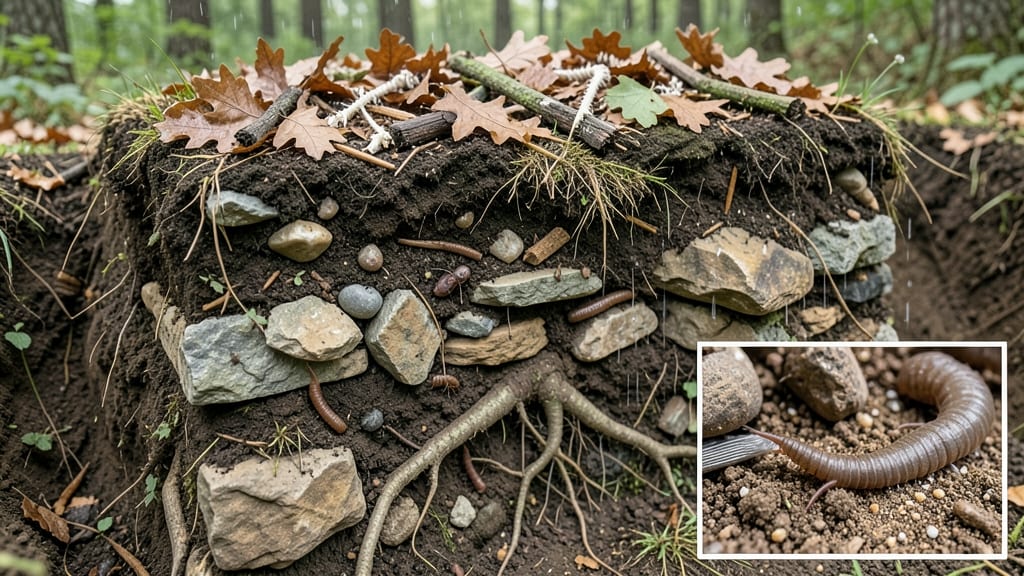
Topsoil is made through centuries-long processes where rocks break down physically and chemically, while organic matter like fallen leaves and plant debris decomposes with help from microbes, fungi, and worms to create nutrient-rich layers perfect for growing plants.
This slow process starts when wind, water, and temperature fluctuations break down bedrock into smaller particles, while organic materials decay into humus. 🌱 Microorganisms play a crucial role by breaking down complex compounds into plant-accessible nutrients, creating the dark, crumbly texture we recognize as topsoil.
Without these biological interactions, soil would remain sterile mineral fragments.
What most people don't realize is that topsoil formation is a delicate balance between destruction and creation. Physical forces like frost wedging and root pressure fracture rocks, while chemical reactions dissolve minerals. Meanwhile, plant roots and microbial communities work together to stabilize the soil structure and enhance its water-holding capacity.
In natural ecosystems, this process takes hundreds to thousands of years to develop just a few inches of topsoil. The thickness varies dramatically—some forests have 6 inches while agricultural lands often lose topsoil faster than it forms due to erosion and poor management practices.
💡 In This Article
- Natural Topsoil Formation: Weathering and Decomposition Science
- Accelerating Topsoil Creation: Human and Agricultural Techniques
Natural topsoil formation: weathering and decomposition science
The foundation of topsoil begins with physical weathering, where natural forces like wind, water, and temperature fluctuations break down solid rock into smaller particles. Imagine a mountain gradually eroding over millennia—freeze-thaw cycles crack rocks apart, while flowing water carries away tiny fragments.
This process creates the mineral base that will eventually become soil, with particle sizes ranging from sand (0.05-2mm) to clay (less than 0.002mm). The resulting texture provides the structural framework for soil development.
Chemical weathering takes this further by altering mineral composition. Rainwater, slightly acidic from dissolved carbon dioxide, reacts with minerals like feldspar, transforming them into clay minerals and releasing essential nutrients like potassium and calcium. This chemical breakdown creates the fine particles that give topsoil its characteristic crumbly texture.
Meanwhile, organic matter—leaves, twigs, and dead plants—begins decomposing through microbial action, forming humus, the dark, nutrient-rich substance that gives topsoil its fertility. 🌱
Microorganisms are the unsung heroes of soil formation. Bacteria, fungi, and actinomycetes break down complex organic compounds into simpler forms plants can use, while earthworms and other macroorganisms mix these materials with minerals.
This biological activity creates soil aggregates—clusters of particles that improve water retention and aeration. Without these living components, soil would remain a sterile mix of minerals with no capacity to support plant life.
Time is the critical factor in this process. In undisturbed ecosystems, topsoil forms at a rate of about 1/4 inch per century, meaning it takes roughly 500 years to create just 1 inch of fertile topsoil.
This slow accumulation explains why agricultural practices must work with—not against—these natural processes to maintain soil health. The balance between mineral breakdown and organic matter accumulation creates the ideal growing medium we rely on for agriculture.
Consider the contrast between forest soils and agricultural lands. A mature forest might develop 6-12 inches of topsoil over centuries, while cultivated fields often lose topsoil faster than it forms due to erosion.
This natural formation process demonstrates why soil conservation is so vital—once lost, topsoil takes centuries to replenish naturally. The interplay between physical forces, chemical reactions, and biological activity creates the foundation for all terrestrial ecosystems.
What makes topsoil uniquely fertile is this perfect storm of components: 25% water, 25% air, 45% minerals, and 5% organic matter, with the remaining 5% being living organisms. This precise balance is what allows plants to access both nutrients and oxygen while maintaining structural stability.
Understanding this natural process helps explain why soil management practices must be so carefully considered in both natural and agricultural settings. 💫